Have Questions? CONTACT US HERE

Wizard Energy
CONTACT

Tag: Electric Rates

  • How to Analyze Your Electric Bill to See What You Really Pay

    Lobbyists for deceptive energy companies and inept bureaucrats have made this way more complicated than it needs to be. Wizard Energy is committed to helping our commercial clints navigate these charges in the bids, contracts, and billing of retail electricity providers to make sure our clients get the best possible electric rate and save tons of money.

    The “real” or “actual” electric rate you pay is the amount you pay each month divided by the amount of kWh (kilowatt hours) of electricity you used.

    CHARGES / USAGE = RATE ( $ / kWh = ELECTRIC RATE )


    Electric Bill in Texas

    1) TDU Delivery Charges (Regulated State Fees)

    2) Rate Charged by Retail Electricity Provider

    3) Fees Added by Retail Electricity Provider

    Let’s go through each of those…

    1) TDU Delivery Charges

    This is what you pay the state to deliver electricity to your business (i.e. service and maintenance of the poles and wires) and the meters that measure it. TDU delivery charges are regulated by the Public Utility Commission of Texas (PUCT). They are impacted significantly by your Peak Demand.

    Peak Demand

    In Texas “demand charges” are based on the highest usage recorded over a 15-minute period for the previous year. Peak demand is measured so power generators know how much electricity is needed to service everyone on the grid.

    If your peak demand is less than 10kW, you pay a base fee plus a rate per kWh:

    Peak Demand Less than 10kW

    If your peak demand is greater than 10kW, you pay a base fee plus a rate per kWh AND a Demand Charge:
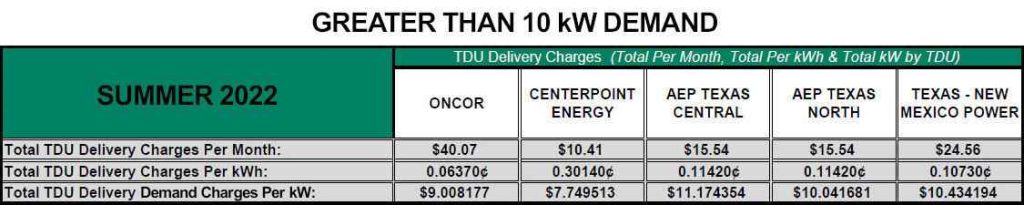
    Peak Demand Greater than 10kW

    2) Retail Electricity Provider (REP) Rate

    REPs will offer customers a rate based on the amount of electricity they and their Load Factor, which is a measure of how predictable your electricity usage is on average.

    If you use power consistently (few or low spikes when you need a large amount of electricity), then the potential for your business to adversely affect the grid is low. In this case, you would be considered a “low demand, high load” customer and tend to pay a lower rate.

    Alternatively, if your business has inconsistent, big spikes in demand for a lot of electricity, then your business can potentially have a negative impact on the grid. In this case, you would be considered a “high demand, low load” customer and tend to pay a higher rate.

    Calculate Load Factor

    (Total Electricity Used (KWh) in Billing Cycle)

    divided by

    (Peak Demand X Hours in Billing Cycle)

    As an example, let’s say your business used 14,000 kWh during the month and your previously established Peak Demand is 25 kW.

    (14,000) / (25 X 720) = .77 or 77%

    This would be considered a high load factor.

    Low: 0-40
    Medium: 41-75
    High: 76+

    Consequently, you are likely to get a better rate offer from an Retail Electricity Provider, like $.03/kWh instead of $.06/kWh. Remember that this rate is in addition to the state-regulated TDU charges for delivering the electricity to your house. Unfortunately, the electricity rate quoted by your REP is not always the sole fee charged to customers. Let’s look at those…

    3) Retail Electricity Provider (REP) Fees

    There should be only 2 fees in your contract/bill: Electricity Rate ($/kWh) & State Taxes/Fees

    Again, unfortunately REPs bury other fees like monthly base fees, minimum usage fees, customer service fees (even for phone calls), etc. These all add up to significantly increase your actual electric rate.

    It doesn’t end there. The worst culprits are not hidden fees but deceptive plans that quote potential customers a rate based on a “Market Rate”. These Market Rates are variable rates based on market conditions that are out of your control like weather events, seasonality, global events, or just odd spikes in demand. These risky plans are called:

    MCPE Plans (Market Clearing Price of Energy) / Indexed Plans / Market Rate Plans

    Instead of your electric bill being a simple sum of (1) TDU Fees + (2) REP Rate + (3) REP Fees + (4) Taxes, you get charged (1) TDU Fees + (2) Market Rate (3) REP Rate + (4) REP Fees + (5) Taxes.


    CHARGES / USAGE = RATE ( $ / kWh = ELECTRIC RATE )

    Let’s go back to our example where your business uses 14,000 kWh/month with a Peak Demand of 25 kW. And let’s say your energy company baited you and quoted an “Indexed Plan” with a rate of $.03/kWh.

    Here’s the reality of what you are going to be charged:

    (1) TDU Fees: $10.41 + (14000 X $.00314) + (25 X $7.749513) = $248.11

    (2) Market Rate: $.12 X 14000 = $1680.00

    (3) REP Rate: $.03 X 14000 = $420.00

    (4) REP Fees: $50.00/month (assumes no other sneaky fees)

    (5) Taxes: $2398.11 X .0625 = $149.88

    TOTAL: $2547.99

    REAL RATE: $2547.99 / 14000 = $.18/kWh

    THAT WOULD BE INFURIATING… The Energy company can quote $.03/kWh and you end up getting charged $.18/kWh… 6X more than you might have been expecting or budgeting for.

    Plus we know how to review multiple bids, decipher the terms and weed out the sneaky fees or deceptive add-ons.

    Save on Your Electric Bill

    GET THE BEST ELECTRIC RATE

    We FORCE electricity companies to compete! Electricity providers will offer a lower price to us because they know they are competing for the business. This drives your price down. Plus we confront all those sneaky practices of hidden fees or deceptive terms.

    Other Ways to Lower Your Electricity Bill

  • Climate Bill Impact on Texas Electricity Rates

    Though the two Republican senators from Texas aren’t fans of the Inflation Reduction Act, few states stand to gain as much. Sure Texas is an oil state but is really is an “energy” state. It is the biggest producer of oil (and gas) in the country, as well as the top refiner. It is also in the top 10 states for coal mining. And Texas produces more electricity from coal than any other state. Even so, Texas is also the biggest state for wind power generation and the Corpus Christi port is a critical entry point for turbine imports. In utility-scale solar power, Texas ranks number two and is catching up to California fast.

    Republican politicians’ vocal antipathy toward renewable energy is at odds with the fact that the vast majority of it is sited in red locales. Texas is a prime example.

    Texas Electricity Grid Bottleneck

    Of the top 10 congressional districts in the country for operating and planned wind, solar and battery capacity, 4 are in Texas, more than in any other state. All are represented by Republicans, and despite their verbal opposition, the state will benefit from existing trends and opportunities.

    Federal investment and production tax credits have been crucial to the expansion of wind and solar power across the US. The new tax credits are more generous and flexible. The maximum $26 per megawatt-hour credit is huge compared with current Texas electricity futures prices for 2024 of about $48 per megawatt-hour.

    Furthermore, renewables were already growing exponentially in Texas due to the state’s deregulated power market, open land, growing electricity demand, high wind speeds and abundance of sunshine. Wind generation overtook coal-fired power generation a couple of years ago. Solar energy, which was slower to get going, pairs well with wind by stepping in during listless lunchtimes on hot days, which have contributed to strains on the grid.

    Texas Electricity Solar Generation

    As of July, ERCOT (the Electric Reliability Council of Texas) counted planned solar and wind projects equivalent to 3X the installed base. Most of that won’t end up getting built, but analysts suggest that even if 30% is realized, wind and solar would supply 1/2 of the state’s projected peak demand by 2025, up from just 23% last summer.

    Let’s add in batteries… There are 69 gigawatts of battery capacity in the project queue versus an installed base of less than 2 gigawatts. In extending a 30% tax credit to battery projects, the IRA will ensure that more of the projects get built. It will also encourage large commercial power customers to install their own batteries as insurance against blackouts. Taken altogether, massive increases in renewables and storage will force further closures of coal-fired plants and reduce reliance on gas-fired plants.

    To realize this continued transition, Texas will need to build more transmission lines to connect remote renewables projects with demand centers and link its own grid with surrounding networks. Wholesale power prices in sparsely populated West Texas have averaged 14% less than in Houston over the past five years. This is an arbitrage that new transmission would close.

    The IRA’s transmission incentives are relatively small ranging from $3 – $15.5 billion. Given the strong existing economic case for new transmission wires, any help could mean the difference between an opportunity being realized or lost. In addition, last year’s bipartisan Infrastructure Investment and Jobs Act provided funds for the grid.

    The permitting legislation would identify 25 strategic energy projects aimed at reducing energy costs, improving energy reliability, decarbonization potential, and promoting energy trade with allies. Transmission hooking up a wind and solar boom in Texas to its own cities and perhaps other states easily meets the first three of these criteria. Given the potential to displace domestic gas demand that could be redirected to exports, the fourth might also apply.

    In addition to addressing energy supply, reducing electric bills in Texas means tackling demand. The state scores poorly on energy efficiency. Cutting load on the grid by 10% would be the equivalent of adding three nuclear reactors’ worth of spare capacity, and it wouldn’t cost nearly as much. The IRA’s $9 billion in funding to cover rebates for efficient appliances isn’t much. Nevertheless, the case for more energy/electricity efficiency in Texas where we have the sixth-highest monthly bills is clear.

    Save on Your Electric Bill

    GET THE BEST ELECTRICTY FOR YOUR BUSINESS

    We FORCE electricity companies to compete! Electricity providers will offer a lower price to us because they know they are competing for the business. This drives your price down!

    Clean Energy Displaces Fossil Fuels

    Everyone would benefit from a grid featuring more renewables, batteries and transmission because it would boost resilience and reduce costs. Even in a decarbonizing economy , Texas’ concentration of low-cost resources and export capacity means its oil and gas production will endure longer than other states.

    Above all, Texas would be a magnet for investment in not just greener energy infrastructure but also the manufacturing encouraged by the IRA’s domestic-content measures. Expanded rebates on electric vehicles, for example, will boost the emerging EV and battery hub around Austin.


    Other Ways to Lower Your Electricity Bill

  • Oncor Reports $229 Million in Profits While Texans Pay Higher Electric Rates

    Oncor is supposed to be Texas’ largest regulated utility, and they are milking residents for an extra $60 million in profits during the scorching heat wave this summer.

    As sweltering temperatures has driven electricity usage to new highs this summer (2022), Dallas-based Oncor’s quarterly profit soared an extra $60M in just one quarter to $229 million. The quarterly profits didn’t include July, which was one of the states hottest months on record.

    Oncor CEO Allen Nye thinks is has been a great quarter… for the company. For residents fighting economic slowdowns and inflation, not so much.

    Texas Electric Rate Oncor

    The second quarter brought on record heat, beginning one of the hottest summers on record. That heat has led to several new peak demand records, with ERCOT peak demand of nearly 80,000 megawatts for the first time in July. The market continues to grow and will require new generation, transmission and distribution resources. Oncor’s service area, the largest in the state, covers all of North Texas and parts of West Texas, Central Texas and East Texas. Oncor will need to be ready to make the investments necessary to support the needs of the growing state. The Texas company added 19,000 additional premises and saw a 73% increase in new transmission point-of-interconnection requests in the second quarter, which is an all-time record for new transmission interconnection requests.

    There is also an increase in major manufacturing expected to arrive in Oncor’s service territory over the next several years.

    A $5 billion silicon wafer manufacturing facility being built by GlobiTech has been approved, on top of another $30 billion semiconductor wafer manufacturing plant project being undertaken by Texas Instruments, both in Sherman. A Samsung chip manufacturing facility, estimated at $17 billion, is also coming to Taylor in central Texas.

    Oncor does not charge customers; instead, customers buy electricity through providers, known as Retail Electric Providers, and Oncor charges the providers for delivering their electricity. The company charges REPs a fixed amount monthly for each customer, plus a charge for how much electricity is used by the customer. Yet, they continue to increase their fees, which end of forcing Retail Electricity Providers to increase the electric rate they charge customers.

    Oncor is justifying the profit grab because it believes the territory has become a powerhouse for manufacturing critical to the future economic and national security of the United States. The profits were driven by increases in revenues from higher customer consumption attributable primarily to significantly warmer weather in the second quarter of 2022 and other factors, including increases in electric rates, the company said in a news release.

    Save on Your Electric Bill

    GET THE BEST ELECTRICTY FOR YOUR BUSINESS

    We FORCE electricity companies to compete! Electricity providers will offer a lower price to us because they know they are competing for the business. This drives your price down!

    Other Ways to Lower Your Electricity Bill

  • Revival Of Nuclear Energy May Help Lower Electric Rates Eventually

    War in Ukraine is causing an energy reset. Western governments are rethinking dependence on Russian oil and gas, and it is a big opportunity for nuclear power to grow and help to lower electricity prices in Texas as well as the rest of the country and the world. Last week Britain announced it will begin developing small scale, modular nuclear power plants. The new energy path is a big win for uranium assets and electricity consumers.

    The emergence of nuclear as a clean energy source seemed unlikely. Nuclear power has been derided for four decades. The number of plants globally peaked in 1996 when 17.5% of all electric power was generated in those facilities. Since then public has opinion soured and the political will to keep plants open waned.

    Nuclear Energy Downfall

    Electricity Prices Goes Up

    Environmental movements gained global traction in the 1970s and nuclear energy was the perfect fall guy. Radiation poisoning was invisible and lethal. This was exploited in 1979 by The China Syndrome, a big budget Hollywood film that mirrored a partial meltdown earlier that year at Three Mile Island, a Pennsylvania nuclear facility. Although epidemiological studies later showed no increase in cancers in the area, fears of living near nuclear facilities grew exponentially.

    A complete meltdown in 1986 at the Chernobyl nuclear reactor led to the depopulation of 68,000 people across 1,000 square miles in northern Ukraine. And 154,400 Japanese were evacuated in 2011 when a nuclear plant in Fukushima was damaged following an earthquake and tsunami.

    Nuclear power plants all over the world began to close. Today these facilities generate only 10.3% of the world’s electricity. It is a contributing factor to electricitiy rates continuing to go higher and higher. The oddity is nuclear power is clean, green, sustainable and statistically much safer than most other forms of power generation, according to research compiled by Our World in Data.

    Nuclear Power Can Be Green and Cheaper for Electricity

    Nuclear facilities are essentially extremely large tea kettles. The power-generation process begins when a uranium atom is split in half to create fission. This releases a tremendous amount of energy. Rods of the fissionable material are cooled in water, creating steam that spins a turbine and creates electricity.

    Most coal or natural gas power plants generate electricity the same way. The difference is uranium is a far more efficient source of energy. A single set of rods the size of a fireplace log holds enough energy to power 100 homes for a year. Uranium is also cleaner. Using it to create electricity does not release carbon into the atmosphere. This is especially as the world races toward zero emissions.

    The Future of Nuclear Energy

    The United Kingdom had 15 nuclear facilities operating in 1997, generating 27% of the country’s electricity. By 2024 only two plants will remain. With the help of Rolls Royce, Prime Minister Johnson wants to reverse the trend. The goal is to build smaller power generation facilities based on Rolls’ nuclear-powered submarine engines.

    It might be the perfect solution for an economy shying away from carbon emissions, and the perils of dependence on Russia oil and gas. The Netherlands, Czechia, Poland, Estonia, Slovenia and Serbia are now studying their nuclear options. Also, the European Union has labelled nuclear power as a climate-friendly investment.

  • Power Wizard in The News

    This story came out back in 2019, but we’re still mistaken for “Power Wizard.” Wizard Energy is NOT Power Wizard. Nonetheless, we do work hard to help people save big money on their electric bills! We’ve been at this for nearly 20 years and are proud of the reputation we’ve developed. Our work is based on honesty, integrity, and impartiality in dealing with electricity companies to get our customers the lowest electric rate to lower your electricity bills.

    We’re an INDEPENDENT energy broker that forces large electricity companies to bid on YOUR BUSINESS in order to get you the BEST POSSIBLE ELECTRIC RATE no matter what!

    Here is the article that was in the Houston Chronicle…


    Power Wizard, a new electricity shopping website in Houston, promotes itself as an independent voice on the side of consumers looking for low cost plans, providing unbiased advice to shoppers because Power Wizard has no ties with retail electric providers.

    Except it does.

    Power Wizard is owned by NextEra Energy, the nation’s biggest utility company, which also owns two retail electric providers in Houston, Frontier Utilities and Gexa Energy, according to registration records on file with the Texas Secretary of State and other public records. The chief executive officer of Power Wizard, Brian Landrum, is also president of Gexa, according to public records.

    “It doesn’t sound very unbiased to me,” said Fred Anders, founder of Texas Power Guide in Houston, a website that helps consumers find the cheapest power plans.

    Power Wizard, which was launched in February, is one of a growing number of concierge-like services in Texas that promise to find the best retail power deals for consumers. The growth in the industry reflects the confusion many Texas consumers face while shopping for power as they wade through gift card offers, free nights and weekend promotions, multi-tiered rates that change based on the number of kilowatt hours used and electricity brokers who promise they can find the best deals. Power Wizard also offers an on-going bill management service for $8 per month.

    Save on Your Electric Bill

    GET THE BEST ELECTRICTY FOR YOUR BUSINESS

    Wizard Energy FORCES electricity companies to compete! Electricity providers will offer a lower price to us because they know they are competing for the business. This drives your price down!

    Power Wizard says on its website that it will navigate electricity buying for its customers as a “totally unbiased” partner. “We don’t have any alliances, relationships, or partnerships with any REPs,” referring to retail electric providers, according to Power Wizard.

    But the address Power Wizard uses with the Texas Secretary of State is the same address of Florida Power & Light, another electricity company owned by NextEra Energy, according to the registration statement Power Wizard filed in February with the Texas Secretary of State.

    All eight executives of Power Wizard work for NextEra, including five who list Florida Power & Light’s address in Juno Beach, Fla. as their business address, according to Power Wizard’s broker application to the Texas Public Utility Commission. Three of the executives, including Power Wizard’s CEO, chief financial offer and assistant vice president of regulatory affairs list NextEra or Gexa addresses in Houston on the registration form Power Wizard filed in August.

    Gexa spokeswoman Ashley DePaolo said that Power Wizard is an affiliate of NextEra, but operates independently of other NextEra business units, including the retail operations of Gexa and Frontier. Power Wizard is not influenced by any retail energy provider or energy broker, regardless of ownership, she said.

    But after being contacted by the Houston Chronicle, Power Wizard removed the claims from its website that it has no ties with retail electric providers.

    As to whether Power Wizard puts customers in Gexa or Frontier plans, DePaolo would not say. PowerWizard selects the best electricity plan on behalf of its members regardless of the retail energy provider, she said.

    Electricity brokers have largely escaped scrutiny in Texas, but a law enacted during the most recent legislative session requires brokers to register with the commission and comply with consumer protection rules and marketing guidelines. The registration deadline was Sept. 1 and about 1,000 brokers have signed up, according to commission records.

    The commission has proposed new regulations for brokers and asked for comments, which will be incorporated into a new rule that will oversee electricity brokers.

  • Electricity Will Be Much More Expensive Next Winter

    Prepare now and lock in your electric rates!

    Electric rates are expected to spike next winter, reaching their highest point in at least two decades on the back of higher energy demand and market turmoil caused by the war in Ukraine. The electric rate could reach 15.6 cents a kilowatt hour, according to estimates.

    If that happens, the rate for many would be nearly double what was just approved by state regulators for the summer. As a result, the monthly bill for a typical residential customer, after delivery and other fees are factored in, would jump from about $111 to more than $150. The prospects aren’t looking good for ratepayers.

    “These are the highest futures prices that I recall in my 10-plus years doing this,”

    James Ruebenacker, manager of wholesale electric supply for National Grid in New England
    Electricity Prices Going Up

    Electric Prices Rising Nationwide

    Electric rates across the nation were already going up coming into this year as the economy started recovering from the COVID pandemic. The average electric price nationwide last year rose at its fastest pace since 2008, according to the U.S. Energy Information Administration. The surge came as the price of natural gas, a major fuel for electric generation, more than doubled. The trend is expected to continue this year.

    Wholesale electric prices this past January hit their highest point in eight years while real-time and day-ahead power prices more than tripled compared to January 2021. The effects are already being felt by consumers… rates climbed 20-25% in January.

    Next winter the country will feel more of the effects of the overheated energy market.

    Electric Rates Tied to Price of Natural Gas

    The last time electric rates approached what’s being projected was in the winter of 2015. Before that, consumers would have to go back to 2008 to find a similar spike in the price of power. Amid a global surge in oil and natural gas prices, the winter rate hit 12.4 cents a kilowatt hour.

    Both previous price hikes came in large part from an increasing reliance on natural gas for power generation. With more power generators depending on the fuel source to create electricity, power suppliers have been thrown into competition with the heating market to get gas. The result has been a pattern of peaks and valleys in electric prices, with increases in the winter when gas needs are high and decreases in the summer when demand ebbs. The pattern has only grown more dramatic in recent years.

    War in Ukraine also pushing up energy prices

    The war in Ukraine is only adding to the upward pressure. European countries are looking for alternatives to Russia for sources of natural gas, meaning that already-high prices to ship liquefied supplies of the fuel are climbing even more.

    Within the next few years, offshore wind is expected to help fill that load, but some regions continue to get as much as 20% of power from oil-burning plants. The electricity from those plants is expensive and is expected to become more costly with global oil prices nearly double what they were a year ago.

    When compared to data going back to 2000, the projected rates will be the highest on record. Even in an apples-to-apples comparison of winter rates only, it still stands out, at nearly 50% higher than other recent peaks.

    Regulators urge Consumers to Prepare for Rate Increases

    Understanding why price increases happen is helpful for many but it doesn’t help pay the bills. Customers are encouraged to reduce usage through energy efficiency programs. By next winter, the price is projected to reach 14.5 cents pre kWh… It is a reflection of global energy markets.

  • Texas Can Phase Out Coal with Wind & Solar

    Texas has enough wind and solar power to phase out coal entirely to reduce Electric Rates, but there’s a catch!

    According to a study by researchers at Houston’s Rice University, it would take just 1/3 of the solar and wind energy projects that have been proposed to phase out coal in Texas.

    The caveat is that the state’s energy grid is a mess, and it is standing in the way of a faster transition in Texas away from coal and toward renewables.

    “Transmission lines are the leading bottleneck that is slowing down the growth of wind and solar,”

    Daniel Cohan, Rice University
    Wind and Solar to Lower Electricity Rates

    Texas is Energy-rich so why are Electric Rates still high?

    As the top U.S. producer of crude oil and natural gas, Texas is easily one of the most energy-rich states in the country. It also leads the nation in wind power generation, which accounts for around 20% of Texas’s energy usage, while the state’s solar power industry is also growing fast. The potential for renewable energy in the state is massive! Unfortunately, Texas is also the country’s largest coal consumer.

    Dirty Energy & Electricity

    As the nation’s largest coal consumer, and biggest electricity consumer in general, how coal is phased out and replaced with clean energy in Texas would be crucial to meeting any nationwide climate agenda and to lead other states in the inevitable energy transition.

    Since June 2020, dozens of the new renewable energy projects have been approved, and the number of new proposals for solar and wind farms has doubled. But there’s still the huge problem…

    Texas Electrical Grid is Embarrassing  

    Different parts of the state can generate more energy at different times. Winds are strongest at night in west Texas, for instance, but tend to pick up during the afternoon in coastal southern regions of the state. You need a power grid to connect all those areas. Simply put, it’s not always windy and not always sunny, but it’s almost always windy or sunny somewhere in Texas. But without an extensive and up-to-date network of transmission lines to connect the electricity generated at these farms to cities, Texas’s energy transition will have to wait.

    In February 2021, Texas was hit by a historic deep freeze that led to prolonged power outages across the state. Although lawmakers blamed wind power and renewable energy for failing during the storm, the major culprit was the electrical grid’s dated infrastructure and aging transmission lines. After the storm, ERCOT, the private company that manages Texas’s electrical grid, came under fire for reportedly cutting corners and loosening regulations, leading to outdated and ill-equipped infrastructure.

    Progress Will Help Electric Rates

    Nationwide, aging electrical transmission infrastructure could soon be updated. In the recently approved infrastructure bill, the federal government laid out a financing plan worth over $15 billion to construct thousands of miles of new lines and upgrade existing ones.

    While Texas’s ERCOT has historically remained inflexible with regard to integrating with the national grids, it is beginning to intertwine itself more with neighboring power systems, such as through the ongoing $2 billion Southern Cross Transmission project.

    Researcher Daniel Cohan at Rice University believes that even though the infrastructure bill is a good start. More attention and investment is needed to sufficiently update the country’s power system. It’s nowhere near the scale of what’s needed nationwide to expand our transmission infrastructure.

  • Bitcoin Mining for Energy Independence?

    Texas Congressman Endorses Bitcoin Mining for ‘Energy Independence’ to Lower Electric Rates

    Bitcoin mining is exploding in Texas. That’s partly because prominent politicians such as Rep. Pete Sessions are courting mining firms.

    The Public Utility Commission of Texas has approved a base rate increase for Southwestern Electric Power Company (American Electric Power). Southwestern Electric Power Company serves 187,500 customers in Northeast Texas and the Texas Panhandle.

    Southwestern Electric Power Company orginally filed its request at the Public Utility Commission of Texas on October 13, 2020. The Public Utility Commission of Texas decision authorized an annual increase of $41.6 million in its order.


    Rep. Pete Sessions, a 12-term Republican congressman from Waco, Texas, is the latest Washington, D.C. politician to publicly embrace Bitcoin.

    He tweeted, “Bitcoin mining will play a critical role in rebuilding energy independence in the USA.” His mini-missive comes three days after Sessions tweeted, in language that mirrors Senator Cynthia Lummis (R-WY), “Bitcoin is aligned with American values and will strengthen the dollar.”

    Texas, once synonymous with oil, is the epicenter of a Bitcoin mining boom. According to data from fall 2021, Texas provides the fourth-highest hashrate of any state, with 14%. But Texas’ influence is likely even higher than that figure, given the large mining facilities that have either begun popping up in the past year or are in the works. For example, Argo purchased 300+ acres in West Texas last spring, while Foundry is partnering with or gobbling up solar and hydroelectric firms in the state.

    Why the Lone Star State?

    “Texas is such a goldilocks zone for bitcoin mining it’s unreal,” tweeted Coin Metrics co-founder Nic Carter over the weekend, citing “supportive policymakers” and the state’s energy infrastructure.

    Sessions is far from the only Texas politician to hail Bitcoin. Senator Ted Cruz has been increasingly aligning himself with cryptocurrency, while Governor Greg Abbott sees Bitcoin mining as a way to stabilize the state’s largely deregulated power grid while taking advantage of its large stores of untapped energy, including natural gas that can be burned but not transported. Texas also has plenty of wind and solar power to go around.

    Texas is such a goldilocks zone for bitcoin mining it’s unreal.

    – Supportive policymakers
    – Energy DNA
    – Most deregulated market, cheap power
    – Islanded grid, has to buy lots of ancillaries
    – Most renewable grid, most negative pricing events

    Texas has the largest net (summer) capacity of any state with 65% more than #2 California, according to the U.S. Energy Information Administration. And its lawmakers want to use that capacity to bring in money from crypto firms.

    “It’s a wonder that there’s mining anywhere else,” tweeted Carter. “Texas is just unreal in terms of mining suitability.”

    Texas now has the perfect opportunity to hone its sales pitch beyond the Bitcoin mining firms it’s been courting to a larger public that is still forming an opinion on cryptocurrency. After Russia invaded Ukraine, the U.S. and allied Western countries levied crippling sanctions against the country. Slight problem, though: Russia supplies an estimated 8% of the world’s oil.

    Therefore, those sanctions, plus voluntary pullouts from companies looking to decrease their exposure to public blowback or inadvertent sanctions violations, has helped push energy prices upward while re-igniting Republican calls for the U.S. to become energy independent.

    In this line of thinking, there’s no need to worry about the consequences of sanctioning Russia if the U.S. doesn’t need the energy it provides (though it can still be hit with higher prices on imports from countries that do).

    Sessions clearly aligns with this view. And he, along with a growing group of Texas pols, is pushing his state to get it done.

  • Electric Rates Are Going Up!

    Texas Commission Approves Southwestern Electric Power Co Rate Increase

    The Public Utility Commission of Texas has approved a base rate increase for Southwestern Electric Power Company (American Electric Power). Southwestern Electric Power Company serves 187,500 customers in Northeast Texas and the Texas Panhandle.

    Southwestern Electric Power Company orginally filed its request at the Public Utility Commission of Texas on October 13, 2020. The Public Utility Commission of Texas decision authorized an annual increase of $41.6 million in its order.


    The Public Utility Commission of Texas approved the increase in base rates to recover Southwestern Electric Power Company’s investments in generation, transmission and distribution facilities since 2016, plus increased operations and maintenance costs to provide reliable and safe service to Texas customers. The Commission also approved cost recovery for the Dolet Hills Power Plant, which was retired Dec. 31, 2021.

    The bill for a Texas residential customer using 1,000 kilowatt-hours (kWh) will increase approximately $8.31 per month, or 8.48%. The increase will begin with bills issued March 1.

    The overall increase includes new base rates, a surcharge to recover retroactive amounts for the base rate increase, and cost recovery for the retirement of the Dolet Hills Power Plant. By Texas law, new rates are retroactive to March 18, 2021. The surcharge for the retroactive amounts will be in effect for an estimated six months. The Public Utility Commission of Texas found the early retirement of Dolet Hills to be prudent and established cost recovery separate from base rates through a rate rider, estimated to be in effect through 2046, the previously Public Utility Commission of Texas-approved life for the plant.

    For commercial, industrial, municipal and lighting rate classes, the new base rate impacts vary by rate class and usage characteristics.

    “The base rate increase is necessary for Southwestern Electric Power Company to continue meeting customers’ expectations and to maintain and operate a strong, reliable electric system,” said Southwestern Electric Power Company President and Chief Operating Officer Malcolm Smoak.

    “We recognize that customers are concerned about their energy costs, especially during the pandemic,” said Smoak. “We will continue to work with customers to help them stay on track with their electric bills.”

    Base rates refer to the costs of building, maintaining and operating Southwestern Electric Power Company’s electric system, including power plants, transmission and distribution lines, and facilities to serve customers. Base rates do not include the fuel portion of the customer’s bill, which pays for fuel and purchased power and is passed through to customers with no profit to the company.

    GET THE BEST ELECTRICTY RATE

    We love to hustle in order to lower your electric bill and save you money…

    …so you make your business better without worrying about overhead!