The impact of recent Department of Energy pauses on export permits on the current and planned facilities for LNG exports
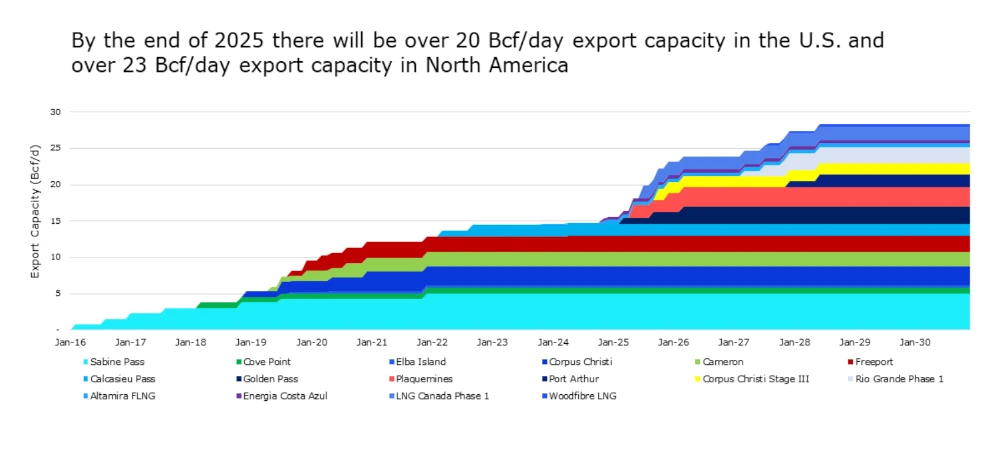
The recent DOE pause could impact projects past mid-2028. The near-term project queue, which is set to add 10.6 Bcf/day of capacity, is unaffected since these projects have already been approved and have the permits under review.
The impact of the Mountain Valley Pipeline to be completed this year
Following the volatility of 2022, basis pricing has been moving in a favorable direction both for the near-term and further out on the curve for the Northeastern markets. Some of the price movement was in response to the loosening of supply/demand coming off a mild 2023. However, since the permits for MVP were expedited, basis is trading significantly lower (over the past year and a half in particular) and, in most cases, is backwardated through 2028. With the expected growth of gas demand from power burn generation and export capacity, it may make sense to lock in that basis value longer term and create a layered approach for your natural gas purchases.
With demand response values down, is DR worth it?
DR values are primarily driven by capacity prices. Although the PJM enrollment season is closing, it’s worth noting that it is the biggest DR market. PJM DR values are quite low historically, but the next capacity auction results are expected this summer, which could have an impact. DR values in other markets, like New York (especially downstate) and New England, are quite strong (as high as $300k/MW in New York City when participating in both the utility and ISO programs). But it really comes down to the ability and willingness of an organization to curtail load for economic benefit.
A Strategic Load Management service could help you prepare for demand response. It could also help with strategies for reducing on peak load days to help lower your capacity and transmission obligations (i.e. “tags”) and thus your cap and trans costs.
Another option to consider that works with or without participation in DR is NRG’s proprietary Responsive Economic Dispatch (RED) program. This program has no penalties but provides an opportunity for you to earn for what you can curtail.
Always sign fixed price contracts but consider other alternatives based on the current index discount.
If you think about your investment strategy, it’s not really about putting all your money into one financial instrument. The same applies to your investment in electricity and energy. It could benefit you to diversify, especially in a dynamic price market. Concern about switching away from the familiarity and simplicity of a fixed price product is not uncommon. However, you have choices in how you manage your exposure to index pricing when you’re not on a straight fixed price plan that allow you to hedge against rising prices, while capitalizing on low pricing or dips as they occur.
A Load Following Block & Index (or LFBI) product offers the ability to layer energy hedges in percentages of your load—including the ability to execute one or multiple hedges to cover 100% of your requirements and eliminate index exposure. With this product structure, if market prices fall such that the index is no longer attractive, you can fix 100% of your load. We like to call this “enhanced fixed price” by achieving your fixed price in layers, with the option to participate in the index market
The El Niño Southern Oscillation (ENSO) region is currently experiencing lingering warm anomalies across the equator, but cooler-than-normal sea surface temperatures (SSTs) across the eastern Pacific. Positive ENSO anomalies are associated with El Niño and negative anomalies are associated with La Niña.
El Niño peaked back in December and has been slowly weakening through early this year. Current forecasts show a more rapid descent toward neutral through spring, then to La Niña by summer. The NOAA ENSO Probabilities indicates a medium chance (50-60%) of having La Niña conditions for early summer and higher chances later in the summer and into the fall.
Summer Weather Outlook
Since the year 2000, summers on average have increased by 6.7 population-weighted cooling degree days (PWCDDs)/year. Degree days are the difference between the daily temperature mean and 65°. While last summer ran hot across Texas, nationally it was under the 2000s trend. The top 10 warmest summers (from 1950 to present) have occurred since 2010, with last summer sliding in as the 10th hottest on record and 2022 as the hottest.
What does a summer La Niña imply? La Niña conditions typically indicate dryer/warmer summer weather.
Winter Power, Gas & Electricity Review
With another above-normal winter, the warmest on record for Dec.-Jan.-Feb. dating back to 1950, the natural gas market is over-supplied. Except for the short-lived January freezing temps, which prompted some volatility, index prices remained stable/low.
We exited winter with gas storage at a significant surplus to the 5-year average, finishing withdrawal season (March) at 2,275 Bcf. Natural gas exports hit a new record of 15.1 Bcf/day (in December) but then dipped in January following the cold weather and maintenance issues at Freeport. NYMEX remained low during December and February and only showed short-lived volatility in January in response to Winter Storm Heather.
Power burn demand set a new record in January and flirted with record 2023 levels for Feb/March. This may continue as we head into nuclear maintenance season if low index pricing continues.
Market Fundamentals of Natural Gas in 2024
Two warm winters ending in storage surpluses have resulted in sustained low prices, including sub-$2/MMBtu this spring. However, the supply/demand balance may be changing. Producers are starting to respond to low prices, with a forecasted 1.5 Bcf/day drop in production this summer over last, recently pushing below 100 Bcf/day which could continue for most of the summer.
Decreased production with increasing power burn demand (coal-to-gas switching) and LNG exports are bullish factors for prices. A hot summer would further increase demand for power burn. Pipeline infrastructure updates will help deliver supplies from key production sites to regions like the East Coast/Mid-Atlantic and Southeast, while regions like the Midwest may see a bullish impact to basis with gas now flowing to other regions.
Near-term pricing remains low compared to historicals, with upside risk outweighing downside opportunity, according to EIA confidence levels.
Buying Strategies
Buying in the shoulder months (spring or fall) might sound like the right thing to do—shoulder months don’t typically have the high demand or extreme weather that can cause price volatility. However, data indicates there’s no trend of consistent buying opportunities in Q2, as prompt month natural gas futures have risen in 4 of last 7 seasons. In 5 of last 7 seasons, the low price point has come between Christmas and end of March, with zero low points during Q2.
Buying in a contango natural gas market because near-term prices have declined—consistently—but long-term prices are higher than near-term and have had modest movement.
Near-term: “Waiting” has worked for the near-term, as buyers have reaped the benefits of the near-term price decline.
Long-term: While long-term prices are higherthan near-term, based on bullish fundamentals, those longer-term prices could rise and therefore today’s prices may be a value. Bullish fundamentals, like increased LNG exports and producer cuts, also make it less likely that longer-term prices will fall.
Regional basis considerations: basis is weak in the east, so a potential strategy in a contango market could include the NYMEX Plus product. You could lock in a longer-term basis then immediately trigger higher percentages for the lower-priced near-term, with a more gradual triggering strategy for the longer-term portion of your contract.
Regional Influences
ERCOT
Demand in Texas is growing much faster than elsewhere in the country and supply from dispatchable resources isn’t keeping up. As a result, net load has become more expensive to serve.
Forward prices for this summer are at or near all-time highs and are disconnected from NYMEX with modest backwardation.
Summer prices beyond this year have recently strengthened significantly given the potential future load growth from residential, AI, crypto, LNG projects, and hydrogen facilities.
When compared to forward prices ($50-60/MWh), the index for most hours of the day has shown value ($20-30/MWh), making forward purchases seem unattractive. But, certain hours on certain days can be in the thousands—which can blow up your index strategy and forward prices—so there may be value in some level of hedging (portions of your load) to protect yourself from extreme volatility and increases in longer-term prices.
Northeast
NYISO Zone J (and PJM as well to some extent) was seeing a downward trend in prices between last summer and this summer, until March-April 2024, when there’s been a sudden jump in long-term prices (’27-’28). This is due to the market being concerned about AI-driven data center load that is increasing across the east. The market is now in a steeper contango.
Near-term is showing the best value. Long-term (2026-2028 moving up), there is time to wait or consider a partial commitment with a lower percent forward hedge.
Non-energy Cost Components
PJM Cap & Trans Costs
Transmission costs are significantly higher than capacity behind most PJM utilities and, when combined with transmission, the two components can comprise 15-40% of your supply price. The next base residual capacity auction scheduled for July will be for the 2025-26 delivery year. Long-term, cap and trans fundamentals are bullish due to the increased reliance in this region on non-dispatchable generation assets and ongoing retirements of dispatchable resources.
NYISO Capacity Costs
Capacity prices are very strong, with in-city capacity up 3.6x in the last 12 months. Capacity costs now comprise 20-35% of supply costs in NYC and 10-15% for rest of state. These increases can be attributed to power exports to Canada and peaker plant retirements.
Strategies to Manage Demand
Consider cap and trans pass-through products with a peak load management program or demand response. Curtailing your load even for a few key hours during the peak load periods could result in savings.
Overall Considerations
Price trends have been favorable overall to start 2024, but procurement decisions remain difficult due to market inconsistencies and bullish longer-term pressures—including the impact of renewable generation comprising a larger chunk of the regional generation stack. A flexible strategy during times of uncertainty could help you better weather the storm through layered purchases for portions of your load requirements for various timeframes. And, if you’re located in PJM, NYISO or ERCOT, you may want to give serious consideration to load management services.
The demand for electricity throughout Texas surged to its highest point ever two days ago (Tuesday, June 27) when rising temps and massive heat dome covered the state. A heat wave continues to bake Texas for two weeks now reaching 100+ temps.
Electricity Demand in Texas is Scorching
ERCOT (Electric Reliability Council of Texas), which operates the grid serving most of the state, reports that electricity demand rose to 80,828 megawatts between 5 p.m. and 6 p.m. Tuesday. That’s the amount of energy needed to power more than than 16.1 million homes while blasting air conditioners. The new record for electricity demand also breaks the all-time peak demand record on the ERCOT power grid. The number tops the previous record of 80,148 megawatts set just last year in July 2022 (76,681 megawatts). That menas this new records happened three weeks earlier in the season. Scary!
Despite triple-digit temperatures and soaring power use, ERCOT issued only 1 request for residents to reduce energy use last week on Tuesday, June 20th. Even so, air conditioners whir around the clock while residents do their best to cool down. The grid operator has issued another weather watch through the end of this week because of the continued weather pattern.
GET THE BEST ELECTRICTY FOR YOUR BUSINESS
We FORCE electricity companies to compete! Electricity providers will offer a lower price to us because they know they are competing for the business. This drives your price down!
In its seasonal summer report released in May, ERCOT forecast that summer demand would hit 82,739 megawatts. The report expects there to be enough electricity supply through the summer, barring the unlikely occurrence of intense heat, widespread outages of natural gas and coal power plants, and a shortage of renewable energy.
Approximately 45% of the electricity on the grid Tuesday evening came from natural gas fired power plants and about 20% came from coal and nuclear plants. About 23% of power came from wind energy, and another 12% came from the state’s rapidly growing fleet of utility-scale solar farms.
Earlier this spring, the Public Utility Commission of Texas (PUCT) warned that there is likely to be a shortage of power supply/production that can be brought online with short notice during extreme summer conditions. Eerily, current data show that peak demand for electricity this summer will exceed the amount we can generate from on-demand dispatchable power.
The state of the Texas electricity grid continues to be a point of anxiety for residents and business owners. It is a complex and evolving issue in Texas politics. In recent years, the grid has come under scrutiny due to a number of factors, including the 2021 winter storm, rising natural gas prices, and the increasing penetration of renewable energy.
Impact on electricity prices for consumers in Texas
The 2021 winter storm was a major test for the Texas electricity grid. The storm caused widespread power outages and left millions of Texans without power for days. The outages were caused by a number of factors, including frozen wind turbines, natural gas production outages, and transmission line failures. The storm highlighted the vulnerabilities of the Texas electricity grid and electricity prices, which led to calls for reforms.
Elevated natural gas prices had a significant impact on electricity prices in Texas and elsewhere, but they have come down of late. As natural gas is the primary fuel used to generate electricity in Texas, the recent volatility has made electricity prices in Texas volatile as well.
The increasing penetration of renewable energy has also influenced electricity prices in Texas. Renewable energy (wind and solar) is intermittent and does not always generate electricity when it is needed. This intermittency can lead to spikes in electricity prices when the demand for electricity is high and the supply of renewable energy is low.
The combination of these factors has led to higher electricity prices for consumers in Texas. In 2022, the average residential electricity price in Texas was 13.93 cents per kilowatt-hour. This is higher than the national average of 12.93 cents per kilowatt-hour. Prices went up everywhere, not just Texas. Even so, the higher electricity prices in Texas have put a strain on household budgets and have made it difficult for businesses to operate.
GET THE BEST ELECTRICTY FOR YOUR BUSINESS
We FORCE electricity companies to compete! Electricity providers will offer a lower price to us because they know they are competing for the business. This drives your price down!
The solution is simple but the process to affect positive change in Texas is complex. The factors that have contributed to higher electricity prices are likely to continue to impact the grid in the years to come. It is important for consumers and businesses to be aware of the challenges facing the Texas electricity grid and to take steps to manage their energy costs.
There are a number of things that consumers can do to manage their energy costs. One is to sign up for a fixed-rate electricity plan. This will protect you from rising electricity prices. Another is to make sure that your home is properly insulated. This will help to keep your home cooler in the summer and warmer in the winter, which will reduce your energy consumption. These changes can save you money on your electricity bills in the long run.
Businesses can also take steps to manage their energy costs. One is to invest in energy efficiency measures, such as installing LED lighting and upgrading to more efficient HVAC systems. Another is to sign up for a demand response program.
This is a program where businesses agree to reduce their electricity usage during peak demand hours in exchange for financial incentives. Demand response programs can help to reduce the strain on the electricity grid and can save businesses money on their electricity bills.
The U.S. Energy Information Administration says in the December Short-Term Energy Outlook that U.S. wholesale electricity prices will be higher and more volatile this winter – from 31% higher than last winter in Texas.
Highlights from the December Short-Term Energy Outlook:
In 2023, U.S. natural gas production is expected to rise to an average of more than 100 billion cubic feet per day for the first time. Pipeline constraints have limited production growth in the Permian Basin of Texas and New Mexico, but the constraints are expected to be resolved more quickly than previously projected.
Crude oil production in Venezuela is expected to rise slightly in the second half of 2023 after the United States ruled that Chevron can resume production there. DeCarolis noted uncertainty in the production forecast for Venezuela but expected production to rise “somewhat next year.”
Electricity generation from wind and solar power in Texas is expected to grow in 2023. Wind power is expected to account for 29% of the state’s electricity generation in 2023, up from 25% in 2022. The share of electricity generation from solar is projected to rise to 8% in 2023, from 5% in 2022. “Renewable sources will play a key role in meeting electricity demand in Texas during peak daytime hours,” DeCarolis said.
It is expected that electricity customers in Texas will pay more for electricity, but retail electricity prices are not expected to increase as much as wholesale prices this winter. The reason is that regulatory and contractual factors vary widely across the United States. During the core winter months – December through February – EIA is forecastes residential electricity prices to average $.145/kWh, which is 6% higher than last winter.
GET THE BEST ELECTRICTY FOR YOUR BUSINESS
We FORCE electricity companies to compete! Electricity providers will offer a lower price to us because they know they are competing for the business. This drives your price down!
The natural gas price at Henry Hub in 2021 averaged $3.91 per million British thermal units, with the 2022 price expected to average $6.48 per million Btu and $5.43 in 2023. In November Henry Hub averaged about $5.50 per million Btu; EIA said it is forecasting a spot price of more than $6 in the first quarter of 2023, with natural gas prices expected to increase from November levels due to higher winter natural gas demand and increasing LNG exports.
The National Oceanic and Atmospheric Administration is forecasting colder weather than last winter from October through March, with 7% more heating degree days than last winter and 2% more than the 10-year average.
EIA said it expects natural gas prices to begin to decline after January as storage levels move closer to a 5-year average but mostly a result of rising U.S. natural gas production.
The agency has raised its forecast for U.S. natural gas production by almost 1% for next year compared to its November forecast. EIA said it has expected natural gas production from the Permian basin to be limited early next year by lack of pipeline capacity but now expects those constraints to be resolved earlier than previously thought.
U.S. natural gas production is forecast to average 98.1 billion cubic feet per day this year, and in November EIA forecast an average of 99.7 bcf per day for next year, a forecast it has now raised to 100.4 bcf per day.
Production of more than 100 bcf per day in October and November exceeded pre-pandemic monthly records from 2019, EIA said, with growth in natural gas production driven by increased drilling activity in the Haynesville region in Louisiana and East Texas and in the Permian region in West Texas and Southeast New Mexico. “Recent pipeline infrastructure expansions in both these regions facilitated the increases in production,” EIA said.
The agency said forecast production in the first half of 2023 is limited by pipeline constraints and declining prices, with more pipeline infrastructure expansion projects scheduled to come online in the second half of the year, contributing to increases in dry natural gas production. “The pace at which these projects are completed is a notable uncertainty in our forecast, and delays could result in lower production than we expect,” EIA said.
LNG TRADE
U.S. natural gas exports are forecast to increase in 2023, “driven largely by growth in LNG exports,” EIA said. Those exports peaked in the first half of 2022 with facilities operating close to maximum capacity and the Calcasieu Pass facility coming online.
A June fire at Freeport LNG, however, removed some 2 billion cubic feet per day of U.S. LNG export capacity. Freeport has announced it plans to come back online in December and increase output to some 2 bcf per day in January.
Once Freeport is back online, EIA said it is forecasting that LNG exports will set a new record, close to 12.5 bcf per day, in March, with U.S. LNG exports expected to reach 12.7 bcf per day by the end of 2023.
No new U.S. LNG facilities are scheduled to come online in 2023, EIA said, and it is forecasting LNG exports in 2023 to average 12.3 bcf per day as facilities continue to operate close to maximum capacity to meet high demand for natural gas in Europe and Asia.
The U.S. also exports natural gas by pipeline to Canada and Mexico and those exports reached almost 9 bcf per day in November, EIA said, near a previous record. During the coming winter months pipeline exports are expected to be between 9 bcf and 10 bcf a day, reaching new record highs.
CRIUDE OIL PRICES IMPACT
EIA said Brent averaged $91 per barrel in November, up from an average of $70.89 per barrel in 2021. The agency is forecasting a 2022 average of $101.48 per barrel and $92.36 per barrel in 2023.
In November Brent reach almost $100 per barrel on Nov. 7, dropping by the end of the month to $86 per barrel. “The price declines were largely the result of market concerns about global economic growth, as well as COVID-related lockdowns in China that have reduced China’s oil demand,” EIA said, adding that despite the recent drop in prices, it expects Brent to be pushed back above $90 per barrel by the beginning of the second quarter on falling global inventories.
EIA said because global petroleum inventories are relatively low and it takes time to rebuild those inventories, the market has limited slack during the forecast period, and any unplanned supply disruption has the potential to increase oil prices quickly and significantly.
After the gnarly 2021 winter storm, the Texas Legislature ordered an overhaul of the state’s power market to prevent future blackouts, but many legislators don’t like the option on the table
The Public Utility Commission of Texas unveiled a proposal (supported by Chair Peter Lake) that intends to pay power generators to make sure they have enough reserve electricity to feed the state’s electrical grid during extreme demand. After proving an ability to keep the lights on during those periods, power generators would receive performance credits. This will cost power customers an additional $460 million yearly, according to the PUC’s estimate. The plan’s complexity and the time it would take to implement such a novel system is in question as well.
There are huge reliability stakes and huge dollar stakes… Texas needs certainty, but there are ways to create certainty without potentially costing billions!
Last year the Texas Legislature ordered the commission to overhaul the state’s energy market, which functions mostly off of supply and demand. During their first chance to weigh in on potential reforms to the market, lawmakers on a key Senate panel this week made it clear they’re not impressed with the commission’s main proposal.
The plan is convoluted and has a long timeline… it’s a set-up for failure for Texas’ residents. The additional costs of the plan will ultimately be paid by power customers too. Many have expressed frustrations with making the state’s power customers pay more for an untested system on top of paying off billions of dollars in costs incurred during the storm event.
Texas residents have had a hard paying for electricity this year. As many cranked up their air conditioners during another sweltering summer, some 45% of Texans had to cut back on other necessities such as food and medicine to pay their electric bill. This is higher than the national average of 34% according to LendingTree.
GET THE BEST ELECTRICTY FOR YOUR BUSINESS
We FORCE electricity companies to compete! Electricity providers will offer a lower price to us because they know they are competing for the business. This drives your price down!
Peter Lake of the PUCT defended the performance credit idea as a way to make the grid more reliable by providing a “market-based solution” to motivate power generators to ensure they produce enough electricity during periods of high demand. He thinks it will deliver an improvement in reliability for less money than.
In adding more money to the flames, the Texas commission paid E3, a California consulting firm, more than $600,000 to figure out what changes to the state’s electric market needed to be made to avoid blackouts during weather events. Of course Peter Lake denied the recommendation to overhaul the grid, which would require electric providers to buy reliability credits.
The good ‘ol boy club flexed its muscle.
But some lawmakers have pointed to what they call flaws in E3’s report, chief among them the fact that the consultant did not take into account weather conditions as severe as those that caused blackouts during the 2021 winter storm. Without that, man say that it’s difficult to know how the grid would hold up during extreme cold or heat as a result of any change — or how much consumers’ energy bills would go up.
According to the E3 report, the consultant does not expect the same levels of outage would be observed during similar weather conditions because of reforms such as new weatherization standards enacted. A PUC spokesperson said the study ran thousands of severe weather scenarios based on historical weather data. But climate change is making weather patterns more erratic creating more and more anomalies. The E3 report also assumed generators would have unlimited access to fuel in case of extreme weather, though many power plants struggled to obtain natural gas to keep running during the winter storm.
Worries also abound that the performance credit system will take too long to implement… up to four years, which will dissuade investment in new power production. Texas has made marginal improvements to the electrical grid but would still see a massive shortfall in power supply should a similar winter storm hit the state in the coming months, according to an October analysis by the Federal Energy Regulatory Commission.
There could be a gap and big risk, which is why the case for change is so urgent.
We have to admit that we rather enjoy jumping on the dogpile of crypto fans
A crypto hodler, crypto investor, and crypto analyst are in front of your house… how do you get them off your porch?
— Pay them for the pizza, cancel the Uber, and ask them to leave the Instacart bags. —
Crypto prices are crumbling but bitcoin continues to stay around $20K. It is just astounding that the price for a line item on a digital spreadsheet made of 1s and 0s of code is still that high. Even so, many “miners” (where are the pickaxes, sledge hammers and hard hats?) are crumbling as spiking electricity prices and lower hash prices (i.e. lower crypto prices) cut into the hodl fantasy business model.
BTC’s price has fallen about 56% year to date, and the sky continues to fall for various crypto and bitcoin miners. Unfortunately one of the causes is higher electricity prices, which also affects those of us in the real world that appreciate history, tangibility, and stability. Furthermore, the global recession is looming while inflation catches up with all the money the Fed printed the last few years and the unnatural interest rate they suppressed to make up for the 2008 financial collapse while they reloaded bankers’ pockets.
GET THE BEST ELECTRICTY FOR YOUR BUSINESS
We FORCE electricity companies to compete! Electricity providers will offer a lower price to us because they know they are competing for the business. This drives your price down!
Hash price is a metric to determine the market value for each unit of hashing power, which is set through changes in bitcoin mining difficulty (which is currently high) and the price of the cryptocurrency. At a high level, the higher the hash rate the greater the difficulty to mine bitcoin — meaning that it takes more electricity to do so. If the electricity price is high, it’s harder to make a profit when they try converting imaginary money back into USD. Who’d a thunk it!
The hash price is near a historical low, and it is about $70.72, down 80.5% from $361.82 a year ago. Additionally, energy prices have increased across many markets, which means miners’ expenses are at all-time highs.
It looks like electric rates will essentially stay the same this fall and winter.
When summer winds down and temperatures cool off, it is usually time to shop for a lower electric rate. But this year prices are not falling simply because of higher generation rates and new fees for the grid are countering the normal seasonal drop we see in Texas. Here’s what you need to know about your electricity bill and how you might find a better electric rate.
What is the price of electricity right now in Texas?
The average price for a 12-month plan is $.16 to $.17 per kilowatt. While that is down from the super-high $.21 rates we were seeing this summer, it is still histrionically high. In the scorching heat of a Houston summer many of us raise our thermostat to76-79 degrees during the day while we’re out of the house, hang items to dry, and avoid the drying cycle on the dishwasher. We do a lot to save, but if your electric contract is up don’t expect to get lower rates right now.
Lower Rate Are Not In The Forecast
Several factors keep electric rates high right now: the price of natural gas needed to make electricity is still high (Russia!). and retail electric providers are worried about another winter storm.
“So now we’re worried about a problem in summer and then we’re worried about a problem in winter. So, what it means is we used to exit summer and I could find a really cheap, like six-month or eight-month contract to get me through the winter. And now winter is sometimes more expensive than summer.
Let’s See About a Better Electric Rate
Some electric companies let customers move into lower rate if you agree to a longer-term contract but you have to watch out for early termination fees! If you’re contract is ending, you can source a better rate now and do it quickly-easily online…
Please note that you will leave this website and connect to Chariot Energy.
Don’t Let Your Electric Contract Auto-renew!
If you have a couple of months before your contract expires, check rates regularly. Prices used to be relatively stable but these days they go up and down significantly.
GET THE BEST ELECTRICTY FOR YOUR BUSINESS
We FORCE electricity companies to compete! Electricity providers will offer a lower price to us because they know they are competing for the business. This drives your price down!
No matter your rate, there are some new fees on your bill you can’t control. Effective September 1st CenterPoint’s delivery charge went from $.038 per kWh to $.049. That’s a 29% increase in the base rate and approximately an extra $11 on the average electricity bill.
Securitization charges are up too in order to provide a safety net for the entire Texas market after the mess from the recent winter storms.
Wizard Energy puts the electricity market in context with real-time information
In Texas, Electricity rates don’t doesn’t exist in a vacuum outside of the whole energy market. To find the right electricity plan for your business (current and future needs), you need to know what is going on in the energy market now and how it will likely trend in the future.
Electricity Rates & energy Update September 2022
Winter weather is more weighted than normal this year because demand is outpacing growth in supply of natural gas and that is affecting power prices.
HISTORICALNEAR-TERM FORECAST
Natural gas production is up about 3.784% from 2021, but most of it was consumed by LNG (export) and electricity generation demand. Meanwhile, natural gas consumption is likely to be at its highest level on record and exceed 2019 levels, per the EIA. Consumption is projected to be up 4.337% from 2021 levels. As is often the case, the biggest factor affecting power energy and electricity prices will be winter weather.
U.S. natural gas consumption likely to increase in all sectors
We expect U.S. natural gas consumption in 2022 to increase by 3.6 billion cubic feet per day (Bcf/d) from 2021 levels to average 86.6 Bcf/d for the year, the highest annual natural gas consumption on record. It looks like U.S. natural gas consumption will increase in all sectors, led by the electric power sector and the residential and commercial sectors.
In the electric power sector, which consumes the most natural gas, annual consumption has increased by 1.2 Bcf/d in 2022 to average 32.1 Bcf/d, which is 0.3 Bcf/d greater than the previous annual record high of 31.8 Bcf/d set in 2020.
When we get our electric bills, we all know this sector is sensitive to changes in natural gas prices relative to coal prices. Many power providers typically offset their use of natural gas with coal for electricity generation when natural gas prices are relatively high.
Impact on Electricity Prices
Despite a large increase in natural gas prices this year, U.S. consumption of natural gas in the electric power sector increased in the first eight months of 2022, averaging 33.2 Bcf/d, which is 2.0 Bcf/d higher than the same time in 2021 and 0.4 Bcf/d higher than in 2020. Over the same eight-month period, the natural gas price at the U.S. benchmark Henry Hub in Louisiana averaged $6.56 per million British thermal units (MMBtu) in 2022, compared with $3.43/MMBtu in 2021 and $1.86/MMBtu in 2020.
U.S. consumption of natural gas in the electric power sector has increased in 2022 due to limitations at coal-fired power plants and weather-driven demand. Coal-fired power plants have been limited in their ability to increase power generation due to historically low on-site inventories, constraints in fuel delivery to coal plants, and continued coal capacity retirements. During both a cold January and a hot summer, natural gas was key to meeting electricity demand peaks throughout the country. We expect natural gas consumption in the electric power sector to decline in the fourth quarter of 2022 and in 2023, in part, due to more renewable electricity generation capacity coming online.
Residential Consumption of Gas / Electricity
We forecast annual U.S. consumption of natural gas in 2022 to have increase by 0.9 Bcf/d in the residential sector and by 0.7 Bcf/d in the commercial sector, driven by high consumption in January. January 2022 was particularly cold, resulting in 9% more heating degree days (HDD) compared with the previous 10-year (2012–2021) average. Natural gas consumption in these two sectors averaged 8% higher than the five-year (2017–2021) average in January, averaging 31.0 Bcf/d in the residential sector and 17.8 Bcf/d in the commercial sector. We expect natural gas consumption in the residential and commercial sectors in 2023 to be similar to 2022 levels.
Texas was once a promised land for bitcoin miners, a business-friendly state with stable regulations and a seemingly endless energy supply. But the tide has turned.
Texas has slowed issuance of new permits for crypto miners to connect to the grid. The state is trying to balance its demand and supply of electricity. There’s virtually no place in Texas where you can just plug into the electrical grid. There are a large number of miners waiting to plug into the grid, and because the amount of available electricity has been low lately bitcoin miners have had to build out their own generators and power lines to power up their computers to mine crypto. That will take a while.
Furthering the pain, Crypto miners have been struggling as the price of bitcoin has slumped and will likely collpase, reducing the miners’ profits and forcing some to sell their mined tokens to cover operating costs.
Lower Electric Rates From Broken Promises
While many companies were successful in building out large-scale operations in Texas, some companies did not get as much power as they initially expected. A slowdown in permitting has felt like a broken promise. There continues to be fire sales of transformers, PDUs (power distribution units) and other equipment that the mining farms can’t use due to power constraints.
A Chinese mining company was planning a 600 MW site in West Texas, and the first phase of the site with a power capacity of 100 MW has been energized. This means electricity is flowing to the mining machines, but the rest is on hold. Is this extra capacaity being added to the grid that is not being used to easy prices? The company had to lay off part of its staff in Texas and a few others left the company in June and July. Other miners with big plans in Texas are Riot Blockchain, Core Scientific, U.S. Bitcoin Corp., and Genesis Mining… will that stick to their development plans in Texas?
In March, ERCOT, which manages large loads on the grid including those for crypto miners, announced an interim process for large energy consumers to connect to the grid. The state needs to figure out how to manage these flexible loads. Right now the state requires large consumers of energy to register and get approval from authorities before they can connect to the grid, which will slow down the build out process for all. Fewer projects have been able to energize per month since the process was established. Although the approval process is a measure to ensure grid stability until ERCOT completes its work, the delay could cripple crypto miners as prices continue to fall.
GET THE BEST ELECTRIC RATE
We FORCE electricity companies to compete! Electricity providers will offer a lower price to us because they know they are competing for the business. This drives your price down! Plus we confront all those sneaky practices of hidden fees or deceptive terms.
How big a drop in demand and the electric rate might we see?
Despite the new, slower procedures, Texas is trying to remain friendly to crypto miners. The state hasn’t overtly said they are no longer looking to attract more mining to the state. ERCOT estimates that 33 gigawatts (GW) worth of bitcoin mining projects planned are waiting for permits, up from 27 GW in mid-July. That volume can be added back to the grid to lower rates. The state expects about 80 GW of peak demand for upcoming summers, compared with 93 GW of energy production based on current and planned resources.
Lower Demand, Lower Electricity Rates
As bitcoin miners and crypto miners continue to melt, will the reduction in demand lower Texas’ electric rates?