Have Questions? CONTACT US HERE

Wizard Energy
CONTACT

Tag: Texas

  • Bitcoin Drop & Eventual Demise to Lower Texas Electric Rates

    Texas was once a promised land for bitcoin miners, a business-friendly state with stable regulations and a seemingly endless energy supply. But the tide has turned.

    Texas has slowed issuance of new permits for crypto miners to connect to the grid. The state is trying to balance its demand and supply of electricity. There’s virtually no place in Texas where you can just plug into the electrical grid. There are a large number of miners waiting to plug into the grid, and because the amount of available electricity has been low lately bitcoin miners have had to build out their own generators and power lines to power up their computers to mine crypto. That will take a while.

    Furthering the pain, Crypto miners have been struggling as the price of bitcoin has slumped and will likely collpase, reducing the miners’ profits and forcing some to sell their mined tokens to cover operating costs.

    While many companies were successful in building out large-scale operations in Texas, some companies did not get as much power as they initially expected. A slowdown in permitting has felt like a broken promise. There continues to be fire sales of transformers, PDUs (power distribution units) and other equipment that the mining farms can’t use due to power constraints.

    A Chinese mining company was planning a 600 MW site in West Texas, and the first phase of the site with a power capacity of 100 MW has been energized. This means electricity is flowing to the mining machines, but the rest is on hold. Is this extra capacaity being added to the grid that is not being used to easy prices? The company had to lay off part of its staff in Texas and a few others left the company in June and July. Other miners with big plans in Texas are Riot Blockchain, Core Scientific, U.S. Bitcoin Corp., and Genesis Mining… will that stick to their development plans in Texas?

    In March, ERCOT, which manages large loads on the grid including those for crypto miners, announced an interim process for large energy consumers to connect to the grid. The state needs to figure out how to manage these flexible loads. Right now the state requires large consumers of energy to register and get approval from authorities before they can connect to the grid, which will slow down the build out process for all. Fewer projects have been able to energize per month since the process was established. Although the approval process is a measure to ensure grid stability until ERCOT completes its work, the delay could cripple crypto miners as prices continue to fall.

    Save on Your Electric Bill

    GET THE BEST ELECTRIC RATE

    We FORCE electricity companies to compete! Electricity providers will offer a lower price to us because they know they are competing for the business. This drives your price down! Plus we confront all those sneaky practices of hidden fees or deceptive terms.

    Despite the new, slower procedures, Texas is trying to remain friendly to crypto miners. The state hasn’t overtly said they are no longer looking to attract more mining to the state. ERCOT estimates that 33 gigawatts (GW) worth of bitcoin mining projects planned are waiting for permits, up from 27 GW in mid-July. That volume can be added back to the grid to lower rates. The state expects about 80 GW of peak demand for upcoming summers, compared with 93 GW of energy production based on current and planned resources.

    As bitcoin miners and crypto miners continue to melt, will the reduction in demand lower Texas’ electric rates?


    Other Ways to Lower Your Electricity Bill

  • How to Analyze Your Electric Bill to See What You Really Pay

    Lobbyists for deceptive energy companies and inept bureaucrats have made this way more complicated than it needs to be. Wizard Energy is committed to helping our commercial clints navigate these charges in the bids, contracts, and billing of retail electricity providers to make sure our clients get the best possible electric rate and save tons of money.

    The “real” or “actual” electric rate you pay is the amount you pay each month divided by the amount of kWh (kilowatt hours) of electricity you used.

    CHARGES / USAGE = RATE ( $ / kWh = ELECTRIC RATE )


    Electric Bill in Texas

    1) TDU Delivery Charges (Regulated State Fees)

    2) Rate Charged by Retail Electricity Provider

    3) Fees Added by Retail Electricity Provider

    Let’s go through each of those…

    1) TDU Delivery Charges

    This is what you pay the state to deliver electricity to your business (i.e. service and maintenance of the poles and wires) and the meters that measure it. TDU delivery charges are regulated by the Public Utility Commission of Texas (PUCT). They are impacted significantly by your Peak Demand.

    Peak Demand

    In Texas “demand charges” are based on the highest usage recorded over a 15-minute period for the previous year. Peak demand is measured so power generators know how much electricity is needed to service everyone on the grid.

    If your peak demand is less than 10kW, you pay a base fee plus a rate per kWh:

    Peak Demand Less than 10kW

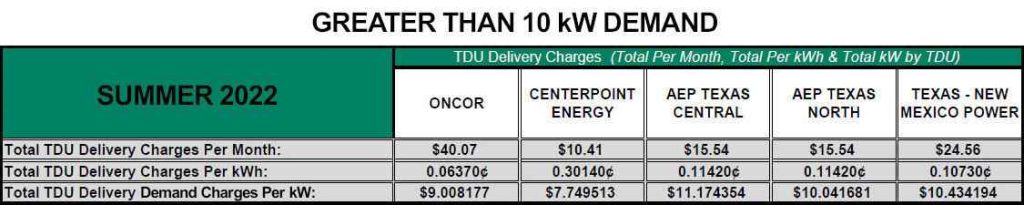
    If your peak demand is greater than 10kW, you pay a base fee plus a rate per kWh AND a Demand Charge:

    Peak Demand Greater than 10kW

    2) Retail Electricity Provider (REP) Rate

    REPs will offer customers a rate based on the amount of electricity they and their Load Factor, which is a measure of how predictable your electricity usage is on average.

    If you use power consistently (few or low spikes when you need a large amount of electricity), then the potential for your business to adversely affect the grid is low. In this case, you would be considered a “low demand, high load” customer and tend to pay a lower rate.

    Alternatively, if your business has inconsistent, big spikes in demand for a lot of electricity, then your business can potentially have a negative impact on the grid. In this case, you would be considered a “high demand, low load” customer and tend to pay a higher rate.

    Calculate Load Factor

    (Total Electricity Used (KWh) in Billing Cycle)

    divided by

    (Peak Demand X Hours in Billing Cycle)

    As an example, let’s say your business used 14,000 kWh during the month and your previously established Peak Demand is 25 kW.

    (14,000) / (25 X 720) = .77 or 77%

    This would be considered a high load factor.

    Low: 0-40
    Medium: 41-75
    High: 76+

    Consequently, you are likely to get a better rate offer from an Retail Electricity Provider, like $.03/kWh instead of $.06/kWh. Remember that this rate is in addition to the state-regulated TDU charges for delivering the electricity to your house. Unfortunately, the electricity rate quoted by your REP is not always the sole fee charged to customers. Let’s look at those…

    3) Retail Electricity Provider (REP) Fees

    There should be only 2 fees in your contract/bill: Electricity Rate ($/kWh) & State Taxes/Fees

    Again, unfortunately REPs bury other fees like monthly base fees, minimum usage fees, customer service fees (even for phone calls), etc. These all add up to significantly increase your actual electric rate.

    It doesn’t end there. The worst culprits are not hidden fees but deceptive plans that quote potential customers a rate based on a “Market Rate”. These Market Rates are variable rates based on market conditions that are out of your control like weather events, seasonality, global events, or just odd spikes in demand. These risky plans are called:

    MCPE Plans (Market Clearing Price of Energy) / Indexed Plans / Market Rate Plans

    Instead of your electric bill being a simple sum of (1) TDU Fees + (2) REP Rate + (3) REP Fees + (4) Taxes, you get charged (1) TDU Fees + (2) Market Rate (3) REP Rate + (4) REP Fees + (5) Taxes.


    CHARGES / USAGE = RATE ( $ / kWh = ELECTRIC RATE )

    Let’s go back to our example where your business uses 14,000 kWh/month with a Peak Demand of 25 kW. And let’s say your energy company baited you and quoted an “Indexed Plan” with a rate of $.03/kWh.

    Here’s the reality of what you are going to be charged:

    (1) TDU Fees: $10.41 + (14000 X $.00314) + (25 X $7.749513) = $248.11

    (2) Market Rate: $.12 X 14000 = $1680.00

    (3) REP Rate: $.03 X 14000 = $420.00

    (4) REP Fees: $50.00/month (assumes no other sneaky fees)

    (5) Taxes: $2398.11 X .0625 = $149.88

    TOTAL: $2547.99

    REAL RATE: $2547.99 / 14000 = $.18/kWh

    THAT WOULD BE INFURIATING… The Energy company can quote $.03/kWh and you end up getting charged $.18/kWh… 6X more than you might have been expecting or budgeting for.

    Plus we know how to review multiple bids, decipher the terms and weed out the sneaky fees or deceptive add-ons.

    Save on Your Electric Bill

    GET THE BEST ELECTRIC RATE

    We FORCE electricity companies to compete! Electricity providers will offer a lower price to us because they know they are competing for the business. This drives your price down. Plus we confront all those sneaky practices of hidden fees or deceptive terms.

    Other Ways to Lower Your Electricity Bill

  • Climate Bill Impact on Texas Electricity Rates

    Though the two Republican senators from Texas aren’t fans of the Inflation Reduction Act, few states stand to gain as much. Sure Texas is an oil state but is really is an “energy” state. It is the biggest producer of oil (and gas) in the country, as well as the top refiner. It is also in the top 10 states for coal mining. And Texas produces more electricity from coal than any other state. Even so, Texas is also the biggest state for wind power generation and the Corpus Christi port is a critical entry point for turbine imports. In utility-scale solar power, Texas ranks number two and is catching up to California fast.

    Republican politicians’ vocal antipathy toward renewable energy is at odds with the fact that the vast majority of it is sited in red locales. Texas is a prime example.

    Texas Electricity Grid Bottleneck

    Of the top 10 congressional districts in the country for operating and planned wind, solar and battery capacity, 4 are in Texas, more than in any other state. All are represented by Republicans, and despite their verbal opposition, the state will benefit from existing trends and opportunities.

    Federal investment and production tax credits have been crucial to the expansion of wind and solar power across the US. The new tax credits are more generous and flexible. The maximum $26 per megawatt-hour credit is huge compared with current Texas electricity futures prices for 2024 of about $48 per megawatt-hour.

    Furthermore, renewables were already growing exponentially in Texas due to the state’s deregulated power market, open land, growing electricity demand, high wind speeds and abundance of sunshine. Wind generation overtook coal-fired power generation a couple of years ago. Solar energy, which was slower to get going, pairs well with wind by stepping in during listless lunchtimes on hot days, which have contributed to strains on the grid.

    Texas Electricity Solar Generation

    As of July, ERCOT (the Electric Reliability Council of Texas) counted planned solar and wind projects equivalent to 3X the installed base. Most of that won’t end up getting built, but analysts suggest that even if 30% is realized, wind and solar would supply 1/2 of the state’s projected peak demand by 2025, up from just 23% last summer.

    Let’s add in batteries… There are 69 gigawatts of battery capacity in the project queue versus an installed base of less than 2 gigawatts. In extending a 30% tax credit to battery projects, the IRA will ensure that more of the projects get built. It will also encourage large commercial power customers to install their own batteries as insurance against blackouts. Taken altogether, massive increases in renewables and storage will force further closures of coal-fired plants and reduce reliance on gas-fired plants.

    To realize this continued transition, Texas will need to build more transmission lines to connect remote renewables projects with demand centers and link its own grid with surrounding networks. Wholesale power prices in sparsely populated West Texas have averaged 14% less than in Houston over the past five years. This is an arbitrage that new transmission would close.

    The IRA’s transmission incentives are relatively small ranging from $3 – $15.5 billion. Given the strong existing economic case for new transmission wires, any help could mean the difference between an opportunity being realized or lost. In addition, last year’s bipartisan Infrastructure Investment and Jobs Act provided funds for the grid.

    The permitting legislation would identify 25 strategic energy projects aimed at reducing energy costs, improving energy reliability, decarbonization potential, and promoting energy trade with allies. Transmission hooking up a wind and solar boom in Texas to its own cities and perhaps other states easily meets the first three of these criteria. Given the potential to displace domestic gas demand that could be redirected to exports, the fourth might also apply.

    In addition to addressing energy supply, reducing electric bills in Texas means tackling demand. The state scores poorly on energy efficiency. Cutting load on the grid by 10% would be the equivalent of adding three nuclear reactors’ worth of spare capacity, and it wouldn’t cost nearly as much. The IRA’s $9 billion in funding to cover rebates for efficient appliances isn’t much. Nevertheless, the case for more energy/electricity efficiency in Texas where we have the sixth-highest monthly bills is clear.

    Save on Your Electric Bill

    GET THE BEST ELECTRICTY FOR YOUR BUSINESS

    We FORCE electricity companies to compete! Electricity providers will offer a lower price to us because they know they are competing for the business. This drives your price down!

    Clean Energy Displaces Fossil Fuels

    Everyone would benefit from a grid featuring more renewables, batteries and transmission because it would boost resilience and reduce costs. Even in a decarbonizing economy , Texas’ concentration of low-cost resources and export capacity means its oil and gas production will endure longer than other states.

    Above all, Texas would be a magnet for investment in not just greener energy infrastructure but also the manufacturing encouraged by the IRA’s domestic-content measures. Expanded rebates on electric vehicles, for example, will boost the emerging EV and battery hub around Austin.


    Other Ways to Lower Your Electricity Bill

  • Oncor Reports $229 Million in Profits While Texans Pay Higher Electric Rates

    Oncor is supposed to be Texas’ largest regulated utility, and they are milking residents for an extra $60 million in profits during the scorching heat wave this summer.

    As sweltering temperatures has driven electricity usage to new highs this summer (2022), Dallas-based Oncor’s quarterly profit soared an extra $60M in just one quarter to $229 million. The quarterly profits didn’t include July, which was one of the states hottest months on record.

    Oncor CEO Allen Nye thinks is has been a great quarter… for the company. For residents fighting economic slowdowns and inflation, not so much.

    Texas Electric Rate Oncor

    The second quarter brought on record heat, beginning one of the hottest summers on record. That heat has led to several new peak demand records, with ERCOT peak demand of nearly 80,000 megawatts for the first time in July. The market continues to grow and will require new generation, transmission and distribution resources. Oncor’s service area, the largest in the state, covers all of North Texas and parts of West Texas, Central Texas and East Texas. Oncor will need to be ready to make the investments necessary to support the needs of the growing state. The Texas company added 19,000 additional premises and saw a 73% increase in new transmission point-of-interconnection requests in the second quarter, which is an all-time record for new transmission interconnection requests.

    There is also an increase in major manufacturing expected to arrive in Oncor’s service territory over the next several years.

    A $5 billion silicon wafer manufacturing facility being built by GlobiTech has been approved, on top of another $30 billion semiconductor wafer manufacturing plant project being undertaken by Texas Instruments, both in Sherman. A Samsung chip manufacturing facility, estimated at $17 billion, is also coming to Taylor in central Texas.

    Oncor does not charge customers; instead, customers buy electricity through providers, known as Retail Electric Providers, and Oncor charges the providers for delivering their electricity. The company charges REPs a fixed amount monthly for each customer, plus a charge for how much electricity is used by the customer. Yet, they continue to increase their fees, which end of forcing Retail Electricity Providers to increase the electric rate they charge customers.

    Oncor is justifying the profit grab because it believes the territory has become a powerhouse for manufacturing critical to the future economic and national security of the United States. The profits were driven by increases in revenues from higher customer consumption attributable primarily to significantly warmer weather in the second quarter of 2022 and other factors, including increases in electric rates, the company said in a news release.

    Save on Your Electric Bill

    GET THE BEST ELECTRICTY FOR YOUR BUSINESS

    We FORCE electricity companies to compete! Electricity providers will offer a lower price to us because they know they are competing for the business. This drives your price down!

    Other Ways to Lower Your Electricity Bill

  • Texas Electric Companies Remotely Change Thermostats

    When Texas went into energy conservation mode last week, energy companies say they adjust some customers’ thermostats due to grid conditions. Residents noticed their thermostat changing on its own. TXU Energy confirmed to media that its Demand Response Program can remotely change thermostats by a few degrees when the power grid is being maxed out. Though tens of thousands of customers participate in the type of plans where electric companies can remotely change a thermostat, it was unclear how many homes had thermostats changed.

    Some consumers say they weren’t aware they had opted into programs granting their energy provider control of their thermostats.

    In June, CenterPoint Energy in Houston also has certain remotely-controlled thermostat programs through EnergyHub… it is disguised as a “rewards program” known as Smart Savers Texas. Customers can opt into the program by allowing EnergyHub and their energy provider to remotely access your thermostat to make adjustments at times of peak electricity demand in the summer. While customers agree to this as a conservation tool, they can usually override the demand response event depending on their plan. Though, not always!

    Shady Electricity Companies

    To lure customers, EnergyHub advertises that when a customer opts in to the program, they are entered into a $5,000 sweepstakes. Customers have to have a so-called smart thermostat, such as Nest, that is connected to the internet. EnergyHub says temperature adjustments typically happen on weekdays from 1:00 pm to 7:00 pm, but may extend outside of that time window for system testing or rare emergency conditions. Customers are supposed to be able to opt out of the program at any time, but some customers say they weren’t aware they were signed up.

    Again, Energy Companies?

    Last summer, energy customers said they found out about their enrollment in a remote access program when they woke up to warm temperatures at home. TikTok users posted videos showing smart thermostats registering an “Energy Rush Hour” alert. The temperatures went up to 83 degrees inside homes and would not revert to user-operated settings for hours after the provider-mandated intervention.

    The customers weren’t aware they were enrolled in a remotely-controlled program, and many unenrolled as soon as they found out.

    High temps have strained the Texas power grid and electricity supply all summer

    The Electric Reliability Council of Texas issued a conservation appeal to all Texans last week asking homes and businesses to reduce their energy usage in the afternoon and early evening. ERCOT also asked Texans to conserve energy this week too. Demand was on the same level as the supply, but no rolling blackouts were reported.

    Texas

    Ready to Simply Get The Lowest Electricity Rate?

    Please note that you will leave this website and connect to Chariot Energy.

    Other Ways to Lower Your Electricity Bill

  • Legal Arguments on $9,000 Electricity Rates in Texas

    The Texas Public Utility Commission’s February 2021 emergency rules allowing an increase in electric rates to $9,000 per megawatt hour in response to Winter Storm were invalid and screwed up the state’s power system.

    Dallas-based Luminant Energy asked a 3-judge panel in the Texas Third Court of Appeals in Austin to declare that the PUC illegally adopted two pricing rules during the historic storm that allowed the Electric Reliability Council of Texas to increase the emergency price of electricity 650% for five days.

    The PUC contended that the energy companies are simply upset because they lost money during Winter Storm and extreme weather conditions.

    Many argue that the PUC decision to set rates at $9,000 for the five days during the winter storm forced many electric providers to pay billions to provide power to their residential and commercial customers, while other electric companies profited by selling power at high rates.

    Impact on Providers & Electric Rates

    The decision by the Austin Court of Appeals will dramatically impact the efforts by more than a dozen electric providers challenging their ERCOT invoices.

    The winter storm that hit Texas on Feb. 14, 2021, caused the electricity to go out in large portions of the state, especially in the Houston area. Power demand surged in other metro areas, and at the same time, many electric generators went off-line because natural gas providers were unable to supply product to electric generators.

    Sneaky Electricity Price Manipulation

    In a six-minute meeting Feb. 15, the PUC decided to address the gap between supply and demand by issuing an emergency reset of the maximum price to $9,000 per megawatt hour, which is way up from $1,200. It also made the $9,000 price retroactive to Feb. 14. The next day, however, the PUC met again and rescinded the retroactive part of its order.

    Electricity Price Competition

    The high-stakes litigation pits the energy companies against each other… Houston-based Pattern Energy, Exelon Generation and Constellation NewEnergy are supporting Luminant in the litigation. All are fighting multibillion-dollar charges as a result of the $9,000 price. Lawyers argued that both emergency pricing rules were invalid for multiple reasons, including the fact that the PUC never filed the rule change with the Secretary of State’s office. This is a case where the agency disregarded legal procedures. It did not follow the law. The PUC has staked out extreme and unprecedented positions.

    Houston-based Calpine Corporation, Talen Energy and TexGen Power support the PUC position. Spring, Texas-based DGP2 and Distributed Solutions argue that the first PUC rule is valid but the second-day rule rescinding retroactivity was illegal. Companies like Luminant are just using the litigation to try to shift their market losses to other parties.

    Texas Assistant Solicitor General, Lisa Bennett (representing the PUC), told the judges that the PUC did not violate Texas law because the agency’s actions were a direction to ERCOT, not rulemaking. She argued that the law provides wide discretion for the PUC to make such decisions because the PUC’s actions were taken during an extreme emergency and because there was a flaw in the system – there were negative reserves, but the price was not going up.

    Hindsight

    When the emergency passed, market participants assessed the financial outcomes of the complex actions they and others had taken in the market during the storm, and some suffered staggering losses. In hindsight, some market participants now want to blame the PUC for their losses and argue that the orders were illegal all along.