Have Questions? CONTACT US HERE

Wizard Energy
CONTACT

Category: Energy Legislation

  • Lubbock Electricity Market Opens up to Competition

    For Lubbock, cost was one of the many reasons the city council decided to take the step to join ERCOT. In a recent study, the utility found that electric costs could drop an estimated $148.9 million annually for the city of Lubbock. Additionally, due to overall electric demand, if Lubbock remained disconnected from the ERCOT grid, the city would require a new power plant with an estimated cost of more than $700 million.

    Impact on Electricity Prices

    In the years leading up to deregulation in the state, electricity prices in Texas were among the highest in the country. Since deregulation, prices have fallen significantly. Like any other product or service (e.g., mobile phone service), it is up to the consumer to make smart buying decisions or pursue calculated risks when selecting an electricity plan based on market conditions or short-term promotions.

    Other Consequence of Electricity Deregulation

    One negative consequence has been higher prices during peak demand periods. This is because the deregulation of the wholesale market has led to a number of power plants being shut down. This has reduced the amount of power available during peak demand periods, which can lead to higher prices during spikes in demand, like during the 2021 winter storm.

    Another potentially negative consequence of deregulation for consumers has been the creation of a number of deceptive plans that have resulted in “rate shock” cases where people have been caught off guard by their utility bill. These are cases in which consumers have been switched to a higher-priced electricity plan without their knowledge or consent. This has led to a number of consumer complaints and has damaged the reputation of the deregulation process.

    Save on Your Electric Bill

    GET THE BEST ELECTRICTY FOR YOUR BUSINESS

    We FORCE electricity companies to compete! Electricity providers will offer a lower price to us because they know they are competing for the business. This drives your price down!

    LubbockElectric.Org

    Lubbock Electricity

    While the Public Utility Commission of Texas regulates the state’s electric utilities, LubbockElectric.org is now available to help customers new to open-market competition. When it comes to an essential utility like electricity in Lubbock, service as import as electricity service, the organization hopes to protect customers and get people the lowest electric rate possible by making mart, informed choices when when they select an electric plan.

    What is electric deregulation?

    In 1999, the Texas Legislature passed a deregulation law that made it possible for consumers in most parts of Texas to choose their own electric company. The new law was passed to encourage free market competition and lower prices. Some areas, such as municipalities and cooperatives, were not required to deregulate, so customers in those areas may not have electric choice.

    What changed in electric service?

    People living in specific zip codes in and around Lubbock can choose their electric company (also called a Retail Electric Provider or REP). What did not change? The same wires companies (also called Transmission and Distribution Utilities) continue to deliver electricity to homes and businesses, regardless of which company is selling a customer electricity. Local wires companies still read meters, respond to service interruptions, and continue to maintain the poles and wires.

    Does everyone in and around Lubbock get to choose their electric provider?

    No. It depends on where in Texas you live. Some communities are served by municipalities, cooperatives, or investor-owned utilities, so electric choice is not available.

    With competition, will the reliability of my electric service change?

    No. Regardless of which electric company you choose, your electricity will continue to be delivered safely and reliably by the local wires company, which is regulated by the PUC.

  • New Plans to Fix Texas Power Grid Will Cost Residents Billions

    The Texas Senate has put forward a number of proposals aimed at improving the state’s electricity infrastructure.

    Senate Bill 6, for example, seeks to establish the Texas Energy Insurance Program, which would provide backup power in the event of an emergency. While some have expressed concerns about the cost of this program, it could ultimately help to ensure that the state’s power grid is more reliable and less vulnerable to blackouts.

    Senate Bill 7 has been criticized for potentially hampering the development of wind and solar power. However, the bill also seeks to ensure that the state’s existing power infrastructure remains competitive and reliable, which could ultimately benefit consumers.

    Senate Bill 2015 aims to increase the use of natural gas in the state’s power generation. While some have expressed concern about the cost of this shift, natural gas is a cleaner and more reliable source of power than coal, and could ultimately help to reduce emissions.

    Sen. Charles Schwertner, R-Georgetown, Lt Gov. Dan Patrick, and Sen. Phil King, along with other lawmakers held a press conference to discuss Texas energy bills in the works in the senate at the Texas State Capitol.

    Patrick and Schwertner want to funnel money away from clean energy and toward fossil fuels just as we need to phase them out to stop global warming. Their proposed laws ignore new technologies that are revolutionizing the electric industry by boosting efficiency and controlling demand.

    Texas’ GOP leadership is trying to destroy the system it built, which encourages companies and technologies to compete to provide the cheapest, most reliable power. Our widely admired free market system would be replaced with the big-government structure we abandoned in 1999.

    They are proposing plans that will drive up customers’ electricity bills, wreck the climate, and further enrich Warren Buffet’s Berkshire Hathaway Energy. These dinosaurs are going to waste billions on archaic solutions for 21st century problems.

    Save on Your Electric Bill

    GET THE BEST ELECTRICTY FOR YOUR BUSINESS

    We FORCE electricity companies to compete! Electricity providers will offer a lower price to us because they know they are competing for the business. This drives your price down!

    If the Dan Patrick’s bills become law, they will destroy the competitive electricity market and return Texas to the era of big government. Republican senators ill have squandered the opportunity to modernize the Electric Reliability Council of Texas grid and bring true reliability.

    Senate Bill 6 establishes the Texas Energy Insurance Program. Senate Business and Commerce Committee Chair Charles Schwertner calls it a statewide backup generator. He wants consumers to pay government-mandated prices for companies to build 10,000 megawatts of natural gas-fueled power plants as backup power for 40 years. That’s enough power for 4 million homes that will sit idle at least 97 percent of the time. So consequently, many look at it and call it a multibillion-dollar waste of money designed to enrich Berkshire Hathaway Energy, earning the company a guaranteed 9 percent rate of return for the company.

    Only the biggest companies would participate. Prerequisites include already operating 15,000 megawatts of generation and possessing $1 billion in assets for every 1,000 megawatts they provide. And Texas consumers would have to pick up a $10 billion price tag to have the brand-new, highly-efficient power plants sit idle, waiting for another, perfectly avoidable crisis.

    Schwertner’s bill excludes battery storage and all other clean emergency power sources. Senate Bill 7 would essentially kill new wind and solar power, which are the cheapest sources of new electricity. The bill forces renewable facilities to subsidize fossil fuel power plants, which is just insane. It seems like the Republicans’ goal is to keep coal plants open and burn more natural gas.

    Senate Bill 2015 puts a bow on Patrick’s plan by mandating that half of the state’s electricity come from natural gas, regardless of the cost to consumers. Everyone would have to pay higher prices for natural gas-generated electricity because the law would force ERCOT to reject cheaper wind and solar energy to obey the law.

    Finally, there is Senate Bill 2012, Schwertner’s and Patrick’s nuclear option if the electricity industry fights too hard against the other bills. It implements the PUC’s favored reliability plan, the Performance Credit Mechanism, but with onerous obligations on generators. The measure would break up the retail electric business, which some generators rely on for profitability. The law would end the prohibition against transmission line companies owning power plants and force them to build natural gas facilities if existing generators do not build enough.

    Lastly, Senate Bill 2404 is a do-nothing bill that establishes a toothless Texas Energy Efficiency Council to make recommendations to future legislatures.


    Ways to Lower Your Electricity Bill

  • Texas’ Proposal to Overhaul Electric Power

    The Public Utility Commission of Texas unveiled a proposal (supported by Chair Peter Lake) that intends to pay power generators to make sure they have enough reserve electricity to feed the state’s electrical grid during extreme demand. After proving an ability to keep the lights on during those periods, power generators would receive performance credits. This will cost power customers an additional $460 million yearly, according to the PUC’s estimate. The plan’s complexity and the time it would take to implement such a novel system is in question as well.

    There are huge reliability stakes and huge dollar stakes… Texas needs certainty, but there are ways to create certainty without potentially costing billions!

    Last year the Texas Legislature ordered the commission to overhaul the state’s energy market, which functions mostly off of supply and demand. During their first chance to weigh in on potential reforms to the market, lawmakers on a key Senate panel this week made it clear they’re not impressed with the commission’s main proposal.

    The plan is convoluted and has a long timeline… it’s a set-up for failure for Texas’ residents. The additional costs of the plan will ultimately be paid by power customers too. Many have expressed frustrations with making the state’s power customers pay more for an untested system on top of paying off billions of dollars in costs incurred during the storm event.

    Texas residents have had a hard paying for electricity this year. As many cranked up their air conditioners during another sweltering summer, some 45% of Texans had to cut back on other necessities such as food and medicine to pay their electric bill. This is higher than the national average of 34% according to LendingTree.

    Save on Your Electric Bill

    GET THE BEST ELECTRICTY FOR YOUR BUSINESS

    We FORCE electricity companies to compete! Electricity providers will offer a lower price to us because they know they are competing for the business. This drives your price down!

    Peter Lake of the PUCT defended the performance credit idea as a way to make the grid more reliable by providing a “market-based solution” to motivate power generators to ensure they produce enough electricity during periods of high demand. He thinks it will deliver an improvement in reliability for less money than.

    In adding more money to the flames, the Texas commission paid E3, a California consulting firm, more than $600,000 to figure out what changes to the state’s electric market needed to be made to avoid blackouts during weather events. Of course Peter Lake denied the recommendation to overhaul the grid, which would require electric providers to buy reliability credits.

    The good ‘ol boy club flexed its muscle.

    But some lawmakers have pointed to what they call flaws in E3’s report, chief among them the fact that the consultant did not take into account weather conditions as severe as those that caused blackouts during the 2021 winter storm. Without that, man say that it’s difficult to know how the grid would hold up during extreme cold or heat as a result of any change — or how much consumers’ energy bills would go up.

    According to the E3 report, the consultant does not expect the same levels of outage would be observed during similar weather conditions because of reforms such as new weatherization standards enacted. A PUC spokesperson said the study ran thousands of severe weather scenarios based on historical weather data. But climate change is making weather patterns more erratic creating more and more anomalies. The E3 report also assumed generators would have unlimited access to fuel in case of extreme weather, though many power plants struggled to obtain natural gas to keep running during the winter storm.

    Worries also abound that the performance credit system will take too long to implement… up to four years, which will dissuade investment in new power production. Texas has made marginal improvements to the electrical grid but would still see a massive shortfall in power supply should a similar winter storm hit the state in the coming months, according to an October analysis by the Federal Energy Regulatory Commission.

    There could be a gap and big risk, which is why the case for change is so urgent.


    Ways to Lower Your Electricity Bill

  • Are Charging Stations on Texas’ Highways Progress?

    Texas is getting the most of any state (it is the largest in the lower 48) and intends to build more than 50 new locations in the first year along major Texas interstates between El Paso, San Antonio, Austin, Dallas, Panhandle, Rio Grande Valley, and Houston using money from the Bipartisan Infrastructure Law from 2021.

    For the next 5 years, the Texas Department of Transportation plans to expand the stations into rural areas and build at least one electric vehicle (EV) charger in every county.

    The announcement comes after Governor Greg Abbott last year warned state agencies, like a petulant child, to be cautious before accepting funds from newly passed federal climate initiatives. Abbott said to avoid the funds if they constrain the state or require an agency to implement a policy that is contrary to the policy of Texas. Unfortunately in our republic, he does represent the citizens, but his idiocy knows no bounds. The man and his cohorts just hate progress, reason, and decency.

    In August, the Inflation Reduction Act included an ambitious climate package with the goal of reducing greenhouse gas emissions and the U.S. economy’s reliance on fossil fuels. The law will provide hundreds of billions of dollars in tax credits and subsidies for clean energy programs and also includes consumer tax credits to buy electric vehicles.

    Though the Inflation Reduction Act passed without any Republican support (take away reason and accountability) based on the idea that it would “punish energy producers.” In other words, it will hurt the people and companies that give them money. Despite Texas Republicans’ political rhetoric and state legislation opposing climate action, TxDOT’s application for electric vehicle charging stations indicates that economics will prevail.

    U.S. Transportation Secretary Pete Buttigieg said that “some of the best use cases for electric vehicles are in places like Texas,” arguing that widespread electric vehicle adoption could save Texans money on gasoline. Though slightly better for the environment, the reality is that it won’t. It just shifts the cost to electricity bills and higher taxes in the form of government subsidies. Why not just be honest and forthright about that?

    The state’s plan is to build 55 new charging locations during the first year. Private companies have already installed 27 charging locations along the targeted highways and 26 more will be funded by the Volkswagen-emissions-cheating lawsuit settlement.

    Save on Your Electric Bill

    GET THE BEST ELECTRICTY FOR YOUR BUSINESS

    We FORCE electricity companies to compete! Electricity providers will offer a lower price to us because they know they are competing for the business. This drives your price down!

    Currently, around 150,000 electric vehicles are registered in Texas. That represents about 1% of vehicles. Current estimates shows Texas will have 1 million electric vehicles by 2028, which is still only a small portion of the 30+ million cars that will be on the road. Moving from 1% to 3.3% is an increase, yes, but that doesn’t really move the needle in terms of decarbonization. Furthermore, is it even practical?

    The state said that will satisfy the federal government’s requirement to have charging stations every 50-70 miles. After your first full charge of your EV, all you have to do is wait an hour to drive another hour or two. At that rate, you can get across the big state of Texas in about 4-5 days. Hilarious!

    The new national climate adviser Ali Zaidi said “If we make it so that it’s not about sacrifice, but it’s about opportunity, I think it becomes irresistible.” Again, comments like this make the shift feel like a it’s just that… a shift and not actually better for anything or anyone. Though slightly better for the environment, the reality is that it will not be. It just shifts the business model of consumerism.

    Though more EVs are being produced and sold every day and the adjustment in energy consumption will create jobs, will the shift really do anything for quality of life (noise, air pollution, the environment, etc.)? Many are skeptical. They are not doubting the science that electric vehicles can be better and are slightly cleaner (almost negligible at this time), but that the shift is just a shift in how most people consume too much and live their lives inefficiently.

    Doesn’t it feel like building a charging station every 50-70 miles is even more saturated than gas stations? What’s going to be the carbon footprint to build those out, building out enough electrical load, building out the grid, and managing all that? We haven’t run the numbers, but this initial step in what will be a lengthy transformation seems ill-advised.

    For now, offering subsidies for more practical hybrid cars and/or home solar seems like it would be a better application of money to help all of us lower our electric bills and really make a progressive step toward decarbonization in the arena that needs to addresses first… where we get our energy and electricity to power all of this electric stuff.

  • Almost Fall – Texas Power Grid Update

    How about this fall and winter?

    Texas lawmakers say changes should provide protection for our Power Grid this winter, but other critical changes will be harder to execute.

    A hearing this week in the State House Energy and State Affairs committees began with an optimistic report that the reliability reforms that were passed in Texas and implemented at the PUC & ERCOT are working. The state continues to switch from the old extra-electricity-when-needed (crisis-based) structure to a reliability-based model that focuses on keeping the lights, heat, and AC running.

    Rules are in place to fine energy producers for non-compliance is up to $1,000,000 per day.

    Nonetheless, the costs for winterization, inflation, and higher energy prices thanks to Russia are driving up delivery charges by some 50%. That doesn’t include the upcharges coming from REPs (Retail Electricity Providers) either!

    It will be a burden on both commercial and residential electricity customers throughout Texas.

    There is concern about additional changes to restructure how energy producers are compensated.

    It could become a turf battle to determine if more power plants are built. But if the state doesn’t get companies to build new power plants, it doesn’t matter what is done in the legislature.

    If additional generation capacity is not added to the grid, we’re going to be in great trouble.


    Ways to Lower Your Electricity Bill

  • Politicians Badmouth Renewable Energy, Then Funnel Money to Constituents

    This summer got too hot too early, which has forced farmers to harvest a month early, slashing yields to 80 bushels per acre from their typical production of 130 to 150 bushels. But many farmers in Texas these days, don’t fret about the weather as much as he used to. Many have 30-year leases with renewable energy companies that have erected large turbines on their land in exchange for a set fee plus a share of the electricity revenue they generate. In a typical year, the extra cash helps farmers pay down land and equipment loans and get a head start on the next crop. This year, lease payments and royalties will cover many of their drought-related losses.

    Renewal Energy Money to Blue Counties While Urban Residents Pay High Electricity Prices

    One of the most active players in communities like this is Engie, a French energy company. It has a wind farm northeast of Waco that began producing electricity in December 2020 with 100 turbines across 30,000 acres and a substation connecting it to Texas’ grid. It has a production capacity of 300 megawatts per day, enough to power 150,000 homes. Engie has two more power projects under construction… another 300 megawatt project called Limestone Wind and a 250-megawatt Sun Valley Solar project. The company also plans to add 100 megawatts of battery storage at Sun Valley to allow it to hold on to electricity that can be released when needed. These will give Engie seven wind and four solar projects in Texas with a combined capacity to produce more than 2.2 gigawatts of electricity. The 200-ton towers are as tall as a football field and are increasingly common in Central Texas. The turbines surprise many who thought they were only in West Texas.

    Renewal Energy Money to Blue Counties While Urban Residents Pay High Electricity Prices

    Inflation Reduction Act

    The legislation provides billions of dollars in tax breaks and incentives to increase renewable energy and affiliated manufacturing designed to drive down carbon emissions. Surprisingly, Texas is already one of the leader in the country for renewables. Only eight states produce more total electricity than Texas does solely from renewable sources. And the industry within the state is growing rapidly too. Wind generation in May increased 32 percent from a year earlier and was 63 percent higher than in May 2018. Solar generation, while still a small part of Texas’ total energy production, was up 545% over 2018.

    Renewal Energy Money to Blue Counties While Urban Residents Pay High Electricity Prices

    Kickbacks to Rural Republican Landowners

    There’s a lot of money involved in these projects. Building new wind and solar projects on the prairie east of where Texas’ Wind industry bloomed puts Engie closer to established transmission lines that can supply metro areas like Houston and San Antonio. Engie spent $300 million to get Prairie Hill Wind up and running, and the Limestone plant is expected to cost about the same. That requires abundant available land and property owners. A land owner who owns 735 acres, is one of 78 who signed leases with Engie. Though many say they were “on the fence” about how the turbines fit into an agricultural environment (noise, aesthetics, damage to roads and infrastructure), they have been more than happy to receive their payouts.

    Renewal Energy Money to Blue Counties While Urban Residents Pay High Electricity Prices

    Projects like these highlight the extent to which investment capital for renewable energy is flowing primarily into blue, Republican strongholds despite the political rhetoric from many on the right. Records show 41 of the 50 (82%) of U.S. congressional districts with the most money going toward renewable-energy projects are represented by Republicans. Even so, Republicans in Congress voted unanimously against the Inflation Reduction Act, even though their districts are poised to reap the expected benefits of increased spending on renewable-energy initiatives. In Texas, Republicans lead 8 of the 10 that are home to the lion’s share of wind and solar projects. Meanwhile, Democratic-leaning metropolitan areas that want to decarbonize their energy sources, have to payout to conservative strongholds and lobbyists that funnel money to blue counties.

    Renewal Energy Money to Blue Counties While Urban Residents Pay High Electricity Prices

    Economic Benefits for Rural Communities & Schools

    Funny enough all that puffery and bluster about the windmills ruining the view and adversely affecting their livestock is gone. Those blue, conservative communities are raking it in. Local schools in rural communities are getting more than their share of tax revenue while urban schools are dealing with overcrowded schools and budget shortfalls. And of course those communities are going to say that renewable power can’t sustain itself without government subsidies… that money is too easy.


    Ways to Lower Your Electricity Bill

  • How to Analyze Your Electric Bill to See What You Really Pay

    Lobbyists for deceptive energy companies and inept bureaucrats have made this way more complicated than it needs to be. Wizard Energy is committed to helping our commercial clints navigate these charges in the bids, contracts, and billing of retail electricity providers to make sure our clients get the best possible electric rate and save tons of money.

    The “real” or “actual” electric rate you pay is the amount you pay each month divided by the amount of kWh (kilowatt hours) of electricity you used.

    CHARGES / USAGE = RATE ( $ / kWh = ELECTRIC RATE )


    Electric Bill in Texas

    1) TDU Delivery Charges (Regulated State Fees)

    2) Rate Charged by Retail Electricity Provider

    3) Fees Added by Retail Electricity Provider

    Let’s go through each of those…

    1) TDU Delivery Charges

    This is what you pay the state to deliver electricity to your business (i.e. service and maintenance of the poles and wires) and the meters that measure it. TDU delivery charges are regulated by the Public Utility Commission of Texas (PUCT). They are impacted significantly by your Peak Demand.

    Peak Demand

    In Texas “demand charges” are based on the highest usage recorded over a 15-minute period for the previous year. Peak demand is measured so power generators know how much electricity is needed to service everyone on the grid.

    If your peak demand is less than 10kW, you pay a base fee plus a rate per kWh:

    Peak Demand Less than 10kW

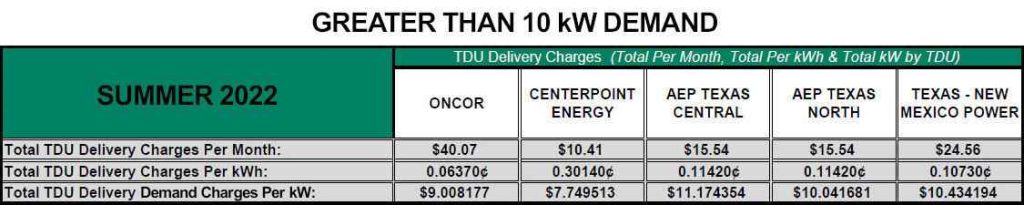
    If your peak demand is greater than 10kW, you pay a base fee plus a rate per kWh AND a Demand Charge:

    Peak Demand Greater than 10kW

    2) Retail Electricity Provider (REP) Rate

    REPs will offer customers a rate based on the amount of electricity they and their Load Factor, which is a measure of how predictable your electricity usage is on average.

    If you use power consistently (few or low spikes when you need a large amount of electricity), then the potential for your business to adversely affect the grid is low. In this case, you would be considered a “low demand, high load” customer and tend to pay a lower rate.

    Alternatively, if your business has inconsistent, big spikes in demand for a lot of electricity, then your business can potentially have a negative impact on the grid. In this case, you would be considered a “high demand, low load” customer and tend to pay a higher rate.

    Calculate Load Factor

    (Total Electricity Used (KWh) in Billing Cycle)

    divided by

    (Peak Demand X Hours in Billing Cycle)

    As an example, let’s say your business used 14,000 kWh during the month and your previously established Peak Demand is 25 kW.

    (14,000) / (25 X 720) = .77 or 77%

    This would be considered a high load factor.

    Low: 0-40
    Medium: 41-75
    High: 76+

    Consequently, you are likely to get a better rate offer from an Retail Electricity Provider, like $.03/kWh instead of $.06/kWh. Remember that this rate is in addition to the state-regulated TDU charges for delivering the electricity to your house. Unfortunately, the electricity rate quoted by your REP is not always the sole fee charged to customers. Let’s look at those…

    3) Retail Electricity Provider (REP) Fees

    There should be only 2 fees in your contract/bill: Electricity Rate ($/kWh) & State Taxes/Fees

    Again, unfortunately REPs bury other fees like monthly base fees, minimum usage fees, customer service fees (even for phone calls), etc. These all add up to significantly increase your actual electric rate.

    It doesn’t end there. The worst culprits are not hidden fees but deceptive plans that quote potential customers a rate based on a “Market Rate”. These Market Rates are variable rates based on market conditions that are out of your control like weather events, seasonality, global events, or just odd spikes in demand. These risky plans are called:

    MCPE Plans (Market Clearing Price of Energy) / Indexed Plans / Market Rate Plans

    Instead of your electric bill being a simple sum of (1) TDU Fees + (2) REP Rate + (3) REP Fees + (4) Taxes, you get charged (1) TDU Fees + (2) Market Rate (3) REP Rate + (4) REP Fees + (5) Taxes.


    CHARGES / USAGE = RATE ( $ / kWh = ELECTRIC RATE )

    Let’s go back to our example where your business uses 14,000 kWh/month with a Peak Demand of 25 kW. And let’s say your energy company baited you and quoted an “Indexed Plan” with a rate of $.03/kWh.

    Here’s the reality of what you are going to be charged:

    (1) TDU Fees: $10.41 + (14000 X $.00314) + (25 X $7.749513) = $248.11

    (2) Market Rate: $.12 X 14000 = $1680.00

    (3) REP Rate: $.03 X 14000 = $420.00

    (4) REP Fees: $50.00/month (assumes no other sneaky fees)

    (5) Taxes: $2398.11 X .0625 = $149.88

    TOTAL: $2547.99

    REAL RATE: $2547.99 / 14000 = $.18/kWh

    THAT WOULD BE INFURIATING… The Energy company can quote $.03/kWh and you end up getting charged $.18/kWh… 6X more than you might have been expecting or budgeting for.

    Plus we know how to review multiple bids, decipher the terms and weed out the sneaky fees or deceptive add-ons.

    Save on Your Electric Bill

    GET THE BEST ELECTRIC RATE

    We FORCE electricity companies to compete! Electricity providers will offer a lower price to us because they know they are competing for the business. This drives your price down. Plus we confront all those sneaky practices of hidden fees or deceptive terms.

    Other Ways to Lower Your Electricity Bill

  • Climate Bill Impact on Texas Electricity Rates

    Though the two Republican senators from Texas aren’t fans of the Inflation Reduction Act, few states stand to gain as much. Sure Texas is an oil state but is really is an “energy” state. It is the biggest producer of oil (and gas) in the country, as well as the top refiner. It is also in the top 10 states for coal mining. And Texas produces more electricity from coal than any other state. Even so, Texas is also the biggest state for wind power generation and the Corpus Christi port is a critical entry point for turbine imports. In utility-scale solar power, Texas ranks number two and is catching up to California fast.

    Republican politicians’ vocal antipathy toward renewable energy is at odds with the fact that the vast majority of it is sited in red locales. Texas is a prime example.

    Texas Electricity Grid Bottleneck

    Of the top 10 congressional districts in the country for operating and planned wind, solar and battery capacity, 4 are in Texas, more than in any other state. All are represented by Republicans, and despite their verbal opposition, the state will benefit from existing trends and opportunities.

    Federal investment and production tax credits have been crucial to the expansion of wind and solar power across the US. The new tax credits are more generous and flexible. The maximum $26 per megawatt-hour credit is huge compared with current Texas electricity futures prices for 2024 of about $48 per megawatt-hour.

    Furthermore, renewables were already growing exponentially in Texas due to the state’s deregulated power market, open land, growing electricity demand, high wind speeds and abundance of sunshine. Wind generation overtook coal-fired power generation a couple of years ago. Solar energy, which was slower to get going, pairs well with wind by stepping in during listless lunchtimes on hot days, which have contributed to strains on the grid.

    Texas Electricity Solar Generation

    As of July, ERCOT (the Electric Reliability Council of Texas) counted planned solar and wind projects equivalent to 3X the installed base. Most of that won’t end up getting built, but analysts suggest that even if 30% is realized, wind and solar would supply 1/2 of the state’s projected peak demand by 2025, up from just 23% last summer.

    Let’s add in batteries… There are 69 gigawatts of battery capacity in the project queue versus an installed base of less than 2 gigawatts. In extending a 30% tax credit to battery projects, the IRA will ensure that more of the projects get built. It will also encourage large commercial power customers to install their own batteries as insurance against blackouts. Taken altogether, massive increases in renewables and storage will force further closures of coal-fired plants and reduce reliance on gas-fired plants.

    To realize this continued transition, Texas will need to build more transmission lines to connect remote renewables projects with demand centers and link its own grid with surrounding networks. Wholesale power prices in sparsely populated West Texas have averaged 14% less than in Houston over the past five years. This is an arbitrage that new transmission would close.

    The IRA’s transmission incentives are relatively small ranging from $3 – $15.5 billion. Given the strong existing economic case for new transmission wires, any help could mean the difference between an opportunity being realized or lost. In addition, last year’s bipartisan Infrastructure Investment and Jobs Act provided funds for the grid.

    The permitting legislation would identify 25 strategic energy projects aimed at reducing energy costs, improving energy reliability, decarbonization potential, and promoting energy trade with allies. Transmission hooking up a wind and solar boom in Texas to its own cities and perhaps other states easily meets the first three of these criteria. Given the potential to displace domestic gas demand that could be redirected to exports, the fourth might also apply.

    In addition to addressing energy supply, reducing electric bills in Texas means tackling demand. The state scores poorly on energy efficiency. Cutting load on the grid by 10% would be the equivalent of adding three nuclear reactors’ worth of spare capacity, and it wouldn’t cost nearly as much. The IRA’s $9 billion in funding to cover rebates for efficient appliances isn’t much. Nevertheless, the case for more energy/electricity efficiency in Texas where we have the sixth-highest monthly bills is clear.

    Save on Your Electric Bill

    GET THE BEST ELECTRICTY FOR YOUR BUSINESS

    We FORCE electricity companies to compete! Electricity providers will offer a lower price to us because they know they are competing for the business. This drives your price down!

    Clean Energy Displaces Fossil Fuels

    Everyone would benefit from a grid featuring more renewables, batteries and transmission because it would boost resilience and reduce costs. Even in a decarbonizing economy , Texas’ concentration of low-cost resources and export capacity means its oil and gas production will endure longer than other states.

    Above all, Texas would be a magnet for investment in not just greener energy infrastructure but also the manufacturing encouraged by the IRA’s domestic-content measures. Expanded rebates on electric vehicles, for example, will boost the emerging EV and battery hub around Austin.


    Other Ways to Lower Your Electricity Bill